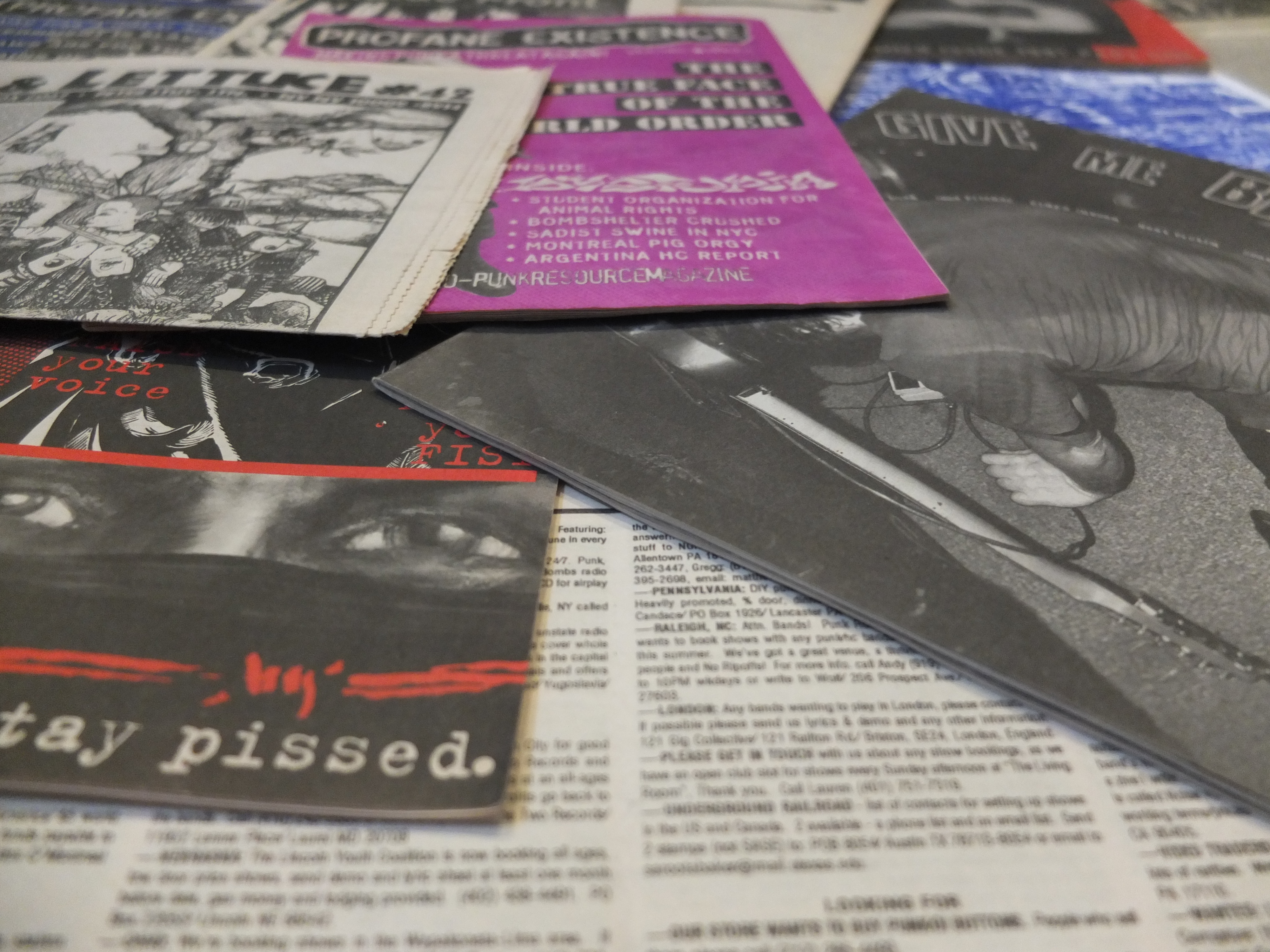
Stephen Dumcombe refers to zines as the public institutions of a subculture.
Maybe it is because I wrote zines more than I played in bands, but it strikes me that zines are a crucial form of communication in punk culture. They might not be as cathartic as music or as immediate as a concert, but they can be sustaining in other ways. Zines can take a number of different forms. They can be personal or political, and usually blend elements of both. They may be the product one of or two individuals or the product of many more more hands and hearts. They can be offset or xeroxed. They are expressions of affection for DIY aesthetics, often deliberately bearing traces of the people who created them. They can knit a community together with the way that they document the dreams, desires, and doubts of the authors. Zines believe in the value of sharing thoughts and feelings and they build community through dialogue. They are often created by women.
The first time I taught a class on punk culture, I knew we had to spend some time reading zines, and one of the most important, to my mind, was HeartattaCk. I had stumbled across a digital archive of this zine years earlier. It was an example of what Abigail De Kosnik calls a rogue archive, an archive that was created and published online without the permission of the original authors and editors. When I looked for it again, it was gone. My attempts to reach the person who created it were fruitless. I have since started to digitize HeartattaCk and engaged one of the original editors, Lisa, in a conversation about creating an archive. I still kind of want to create a book that collects the entire span of 50 issues. And then I noticed that someone else had published yet another rogue archive of the zine online.
These experiences have led me to wonder about how our culture is being archived and what sorts of things we need to think about when doing so.
I believe in the value of archives.
I believe in the value of punk and I am still inspired by learning from our youthful mistakes as well as our unbridled enthusiasm. I don’t want to see these things disappear into private collections.
I believe older zines are still worth reading today.
But I am not sure if they should be archived how they are right now. They were created at a particular time and place, for a specific audience, and without any expectation that they would become publicly searchable a generation later. Many writers use pseudonyms. Many did not.
What do we understand copyright to mean when it comes to creating a public archive of HeartattaCk? Of course there aren’t any copyright statements in the zine. A lawyer will tell you that the law creates a copyright on intellectual content and publications whether one wishes it to or not. Creative commons licenses were not something punks were thinking about a generation ago. What would be appropriate community guidelines where permissions do not exist? The most prevalent model comes to us from music-sharing blogs: “let me know if you don’t want your material shared.” Is that enough?
Who would give permission to create an archive that shares HeartattaCk with anyone who cares to read it online? Is it up to Lisa and Leslie, the editors of the zine, to decide? Do contributors get a say as to whether or not their columns see the light of day in a digital public archive?
So, archiving HeartattaCk, or any other zine, is a complicated matter. But it is one well worth thinking about.
By George Grinnell
I constantly hear about the lack of women in punk, and the lack of active women, but there really are a ton of active women doing so much stuff. There may not be a ton of women in bands (though there certainly are several), but since when is punk supposed to be all about the bands? There are many women currently kicking ass doing so many things, and there have been many women in the past to for inspiration
Leslie Kahn
 Punk Pedagogy