An autoethnography of what it would mean to make paper zines digital and public
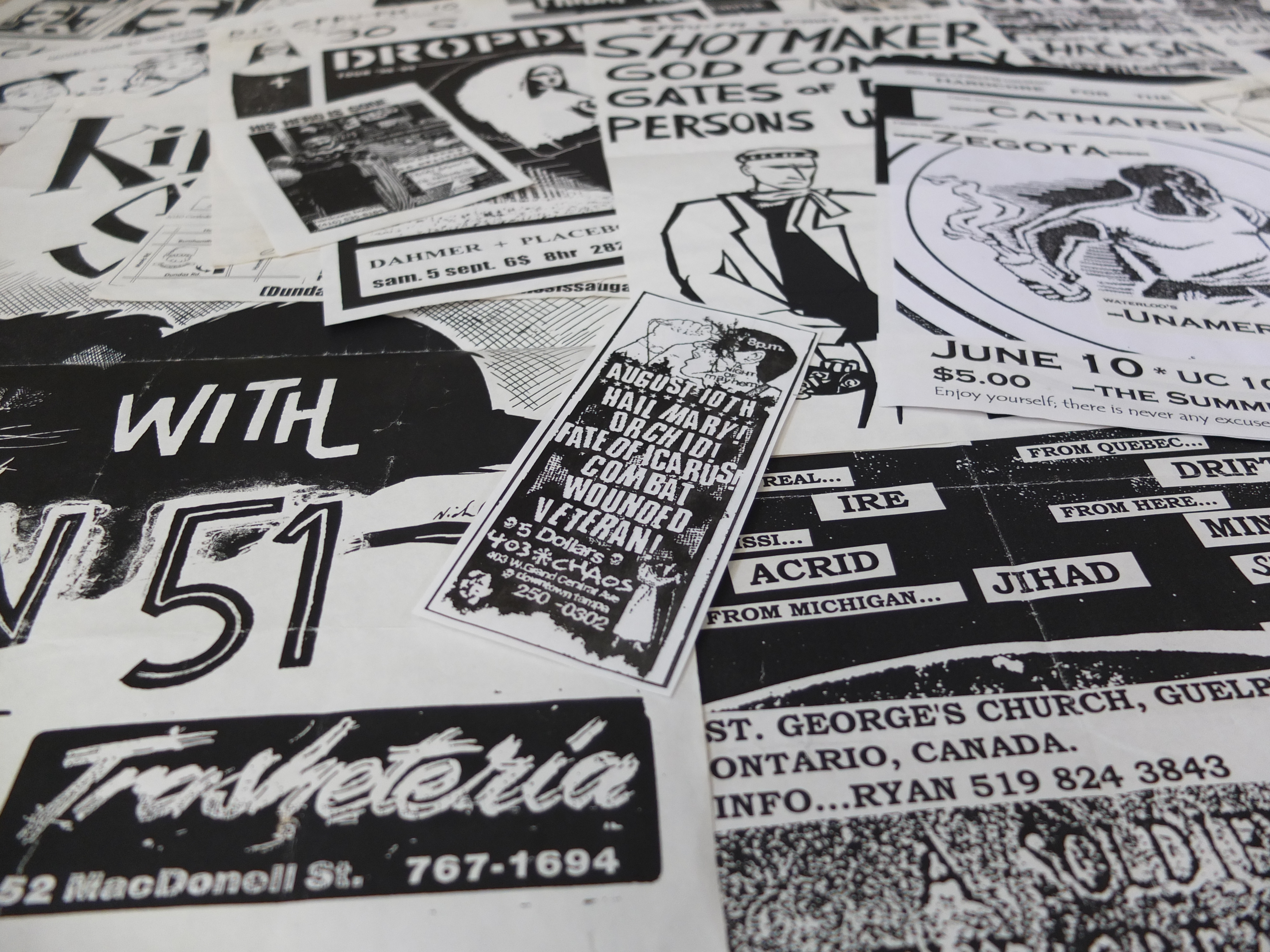
What does it mean to make paper zines into open digital zines? What sort of ethical issues does this raise and for whom might they be most pressing? In what sense is the creation of a zine fundamentally different from the digital distribution of a zine?
In what follows, I share my own experiences making zines with others and discuss some of the issues that come to mind when I think about sharing these online.
Context
As part of the Sexual Assault and Rape Awareness (S.A.R.A.) Campaign’s event programming at UBC, we facilitate a monthly zine creation workshop. The funding for this student led initiative is supplied by the Student Experience Office, as well as the location, which is on campus in either the Junior or Senior level collegium. The supplies we use to create zines are magazines found on campus beside recycling bins, art supplies left over from past events, or craft materials supplied by the Student Experience Office. As S.A.R.A. is a student led campaign the entirety of the planning, promotion, and facilitation work is based on student labour.
Our topics include but are not limited to: sexual health, gender and sexual identity, experiences within the patriarchy, approaches to dismantle rape culture, mental wellbeing, party safety, reclaiming the female body and female identities, creating inclusive spaces, voices of the marginalized, healthy relationships (sexual and aromantic), respectful flirting, consent, self-care as an activist, and being a better ally.
We invite all members of the campus community to contribute to our zine and we accept digital submissions throughout the year as well. At the end of the year, we scan and compile all the artworks into a zine that give out during events or to anyone who is interested in having a copy.
Our zine sessions are situated within a very specific circumstance and when I consider the possibility of our collective material being posted on a digital platform, many issues arise.
Atmosphere
This may be an idealized vision of S.A.R.A.’s zine workshops, but the comfortable space that we cultivate for these workshops would be impacted with the end goal of posting our artworks online. Fundamentally, I see us as a collective group of weirdos who come together to express a multitude of issues we are dealing with. None of us are in it for recognition, money, or anything concrete. Although we create a zine at the end of the year, most of our contributors rarely care to see the finished zine.
The act of creating the zine is more important than the final product.
To be honest, I am not sure how digitally preserving our zine would impact the process, and I hesitate to say the spirit of zine making will be lost but something would change. What that ‘something’ is, I am unsure.
Heavy Issues
The topics we cover can deal with weighty social and political issues regarding sexual violence. We also have submissions that are funny and silly but, a great deal of our art work grapples with topics that are difficult to address. We have had submissions that grapple with confronting a perpetrator of one’s own sexual assault, body dysmorphia, and leaving an abusive relationship.
The ability for contributors to be vulnerable is incredibly powerful but with the prospect of digital preservation I wonder if contributors would feel as comfortable to share their story.
Absolutely, the comic/poem/collage could be anonymous. But would a survivor of sexual violence, or any traumatic experience, risk having their story revealed if they want to remain anonymous? Even if the story is not traumatic – for example, one funny submission that tells the story of masturbating for the first time as a teenage girl and the awkwardness that accompanies that experience – many stories in the zine remain personal and it is not in my best interest to assume that this person would want their story shared. On the other hand, tales of survival and empowerment are always needed on online platforms. What, and who, is at risk when these stories are posted remains a significant problem and is this a risk worth trying to balance against potential benefits, as if it is for us to decide what costs are acceptable?
Permanently Online
An important aspect to consider when evaluating risk is the permanence of online documentation. Considering the topics we cover, ranging from silliness to working through trauma, the online preservation of these stories has the potential to re-victimize or be literally dangerous to contributors. As mentioned earlier, part of the cathartic experience of our workshop is to creatively express feelings in a supportive atmosphere with no repercussions. Could online preservation haunt contributors in their future opportunities in ways that we cannot yet foresee? What if a family member, friend, or abuser finds a familiar narrative online? In such a scenario, even anonymity is not likely to protect the author because those who know will know.
And what of instances where anonymity enables the false assumption one knows who really wrote it?
How would S.A.R.A. ensure the safety of our contributors? Permissions can be granted, but if creators know it is going to be online forever, how would online permanence impact what students contribute? Some of my favourite contributions are a few magazine clippings haphazardly thrown together with some written words. Would creators feel pressure to create something elaborate to which they can proudly sign their name? Would this create competition, which is really not part of the spirit of zine making, in my opinion?
Never Permanent Enough
How could we outline and be clear about all the potential dangers, when we are unsure of how their works could be used in the future? There is no sure way, at least that I know of, to permanently delete content online. Once a work is posted, it has the potential to be circulated widely, saved, and manipulated.
Even if one wished to see one’s contributions go online, this is no guarantee that they are not manipulated and re-circulated in a bastardized fashion in order to harm the author or others.
This is a scary prospect especially when students come to our workshops to release feelings and not confront the complex issues of online documentation.
Consent
Consent is a mutually communicated, enthusiastic, and ongoing conversation. How would I obtain consent to post zine art works online from multiple people and make sure that they are continuously comfortable with their decision? The decision one makes at 22 might not be the decision one wished to have made at 36. What happens if a student originally wanted to share a story and now they changed their mind? Who has the authority to delete and edit the site? Does every contributor have access to the website and at their leisure they can upload or delete works? In a university context, who owns these stories and art works? Are there legal liabilities that could arise for the university?
By Lea Rose Sebastianis
I constantly hear about the lack of women in punk, and the lack of active women, but there really are a ton of active women doing so much stuff. There may not be a ton of women in bands (though there certainly are several), but since when is punk supposed to be all about the bands? There are many women currently kicking ass doing so many things, and there have been many women in the past to for inspiration
Leslie Kahn
 Punk Pedagogy