Comparing Formal Education and Punk Pedagogy
In what follows, I offer a fictional account of what I think is a pretty typical scene from school. It is a story about Kaylee Williams taking a test and then getting sent to the Principal’s office.
After this initial illustration, I examine some of the core principles of pedagogy that writers discuss in HeartattaCk #38, The Education Issue, in order to document the value of these ideas and consider how they might transform the initial story and how we think about what education can be and should be.
Then, I offer a new version of Kaylee’s story. This version is inspired by the lessons of a punk pedagogy and inspired to further share the potential of this issue of HeartattaCk to change the world in meaningful ways with the conversation it starts in this issue regarding education.
I wonder what it might be like for others to discover an old copy of HeartattaCk zine, as Kaylee does, and why it might still matter for them, even and especially if they aren’t punk kids? Could it be that digital copies of HeartattaCk can reach audiences that the originals did only rarely, attracting readers who might be more interested in the punk politics of the zine than the music and subculture that it stitched together? To what extent are its ideas relevant far beyond punk circles? Could it demonstrate the potentially broad reach of a punk pedagogy that helps people to reflect on the world around them as well as themselves? Could it help others to find a sense of community and to transform communities to which they already belong?
Mrs. Schneider’s class is always pretty dull. Grade 11 Humanities, it’s called. When I came home with my new year’s school schedule a few weeks ago, Mom didn’t know what that meant. I told her, it’s basically history with a side of present-day politics stuff.
“Okay class, who can tell me the causes of the Second World War?” Mrs. Schneider is a petit set woman with frizzy hair and colourful glasses that hang from a beaded string around her neck. She does her best to sound enthusiastic but realistically, so do the birds out the window.
I’m playing the bent corners of a magazine I found in the attic when I was visiting my dad’s on the weekend. I’ve got it pressed between a pale green binder I colour coded for humanities class, and the day planner the school provides at the start of every year that hardly anybody ever uses.
The magazine was weird. It’s called heartattack, and when I Googled it on my phone, on the drive home I found out that it was some punk magazine from like, a long time ago. Like I said, it was weird. I mostly skipped past all the words and just looked for the pictures but I could hardly understand them. They were all political sketches or ads for concerts and stuff.
“All right, everything away students,” Mrs. Schneider calls to the class, holding a small stack of papers. “Were going to test your knowledge a bit.” She hands a stack to each of the students and says, “Take one and pass it on. This isn’t for marks, but I want you to work alone. I can gage where the class it at learning wise. And remember, if you talk about Pearl Harbor do not talk about Ben Affleck. Understood?”
I get the test from Zack Larkey, super cute, plays on the lacrosse team and super smart too. When he hands the sheet back to me, he smiles at me a bit. Unless he was smiling at the Ben Affleck thing.
I write my name in the top, right-hand corner of the test, Kaylee Williams, and read through the questions. It’s only short answer. Mrs. Schneider says for short answer questions, it’s about the 5 W’s: who, what, where, when, and how. Except “how’s” not a W and that’s always bothered me.
Question 1: What were the main causes for America’s entering the WWII?
Uh oh. I feel the Ben Affleck thing coming on. I start listing the events of Pearl Harbor and try not to express my opinions on the tragic love story at the heart of it all.
Question 2: What were the first Western European countries Germany invaded and why?
I don’t really know this one. One of them was definitely Poland, right? Oh wait, wasn’t it Belgium? Or is Belgium in Germany already? No that’s Berlin. Dammit.
I slide my phone out of my pocket under my desk and type a quick message to Maddy reading: #2? My friend Maddy sits one seat to forward and to the left of me. We try to keep space between us so that we both sit next to Zack Larkey.
Def Norway
She’s right of course. Now I remember that map. The only thing West of Germany is Norway. And maybe Demark, but I think that’s more above it. It’s when I’m sliding my phone back into my pocket that it happens. My thumb slips on the top of my phone case and my phone falls to the floor. The sound is deafening. It startles the whole class and everyone turns to look at me. Dammit. Now I’m toast.
“Miss Williams,” Mrs. Schneider steps over from between the on-looking students. “Is that your cell phone?”
I don’t answer. I just scoop my phone off the floor.
“Were you using it during the test?”
“I thought you said this wasn’t a test?”
She holds her hand out for the phone and I give it to her. The message on the home screen reads: Magic Markles: Def Norway. Thank god Maddy always messes with the contact names in my phone.
Mrs. Schneider reads, “Magic Markles?” Looking around the room. “Is there anyone here who answers to Magic Markles?”
The class stays silent and I avoid looking at Maddy. Thank god Mrs. Schneider never pays attention to who we walk in to class with.
“All right, Ms. Williams, to the principal’s office. I’ll call and tell him you’re on your way.”
Great. Zack Larkey will never date me now. I grab my stuff and exist the class as quickly as I can.
The walk to the principal’s office is short but I stretch it as long as I can. On my way I pass a group of Booster mom’s setting up a table for a bake sale. These one’s look like they’re from volleyball judging from the painting on the poster hanging on the wall behind them. I used to love volleyball but then I had to drop out because Dad lives out of town and can’t be in the carpool for weekend tournaments.
In the main office, I walk past the receptionist to Mr. Turner’s private office and knock lightly on the door.
Mr. Turner looks up. “Ah, there you are,” he checks his note pad in front of him, “Ms. Williams?”
“Yes.”
“Good. Have a seat.” He gestures to the chairs opposite him with his desk in between. I’ve never been in the Principal’s office before. I look around the room and take in the wall posters. One says, Inclusion is the only solution! The next one reads Let’s make success more Access-able! They’re cheesy but not the worst.
“So Ms. Williams, you were caught cheating on a test. Is that right?”
“No, it wasn’t a test.”
“Okay, no judgment. The bell is about to ring and then Mrs. Schneider will be joining us to explain the situation,” He says, probably trying to be comforting. “You can just work quietly until she gets here.”
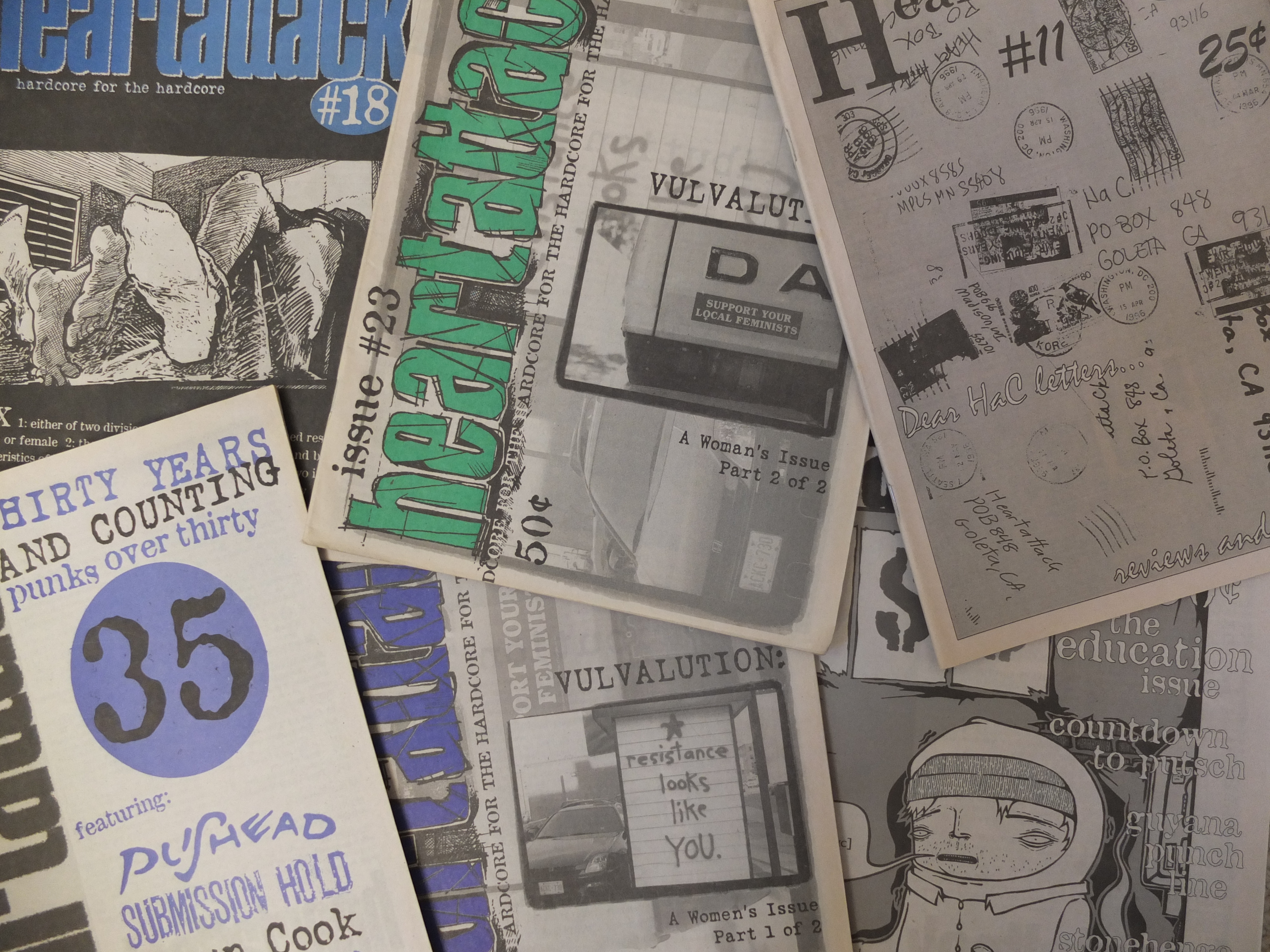
Work quietly? On what? I fidget with the bent corners of the magazine and then pull it out of my stack of books. The front cover says: “the education issue,” “countdown to putsch,” “guyana punch line,” and “stonehendge records.” Not that I know what any of that really means. I flip through the first few pages again and this time stop to read a bit. I stop on an article on page 12 written by Veracious V. She sounds pretty cool. She says she dropped out of school and now is all about teaching herself stuff. Then she goes on to rag on schools, calling them, “racist, capitalist, patriarchal, paternalistic, heteronormative and homophobic, ageist, ableist, technocratic, bureaucratic, right-wing” industries that are trying to “divide and conquer, to control, subdue and subvert the masses as a tool for maintaining social hegemony and the status quo.” She could probably chill a bit, but at least she cares about stuff.
I’m googling “hegemony” on my phone when Mrs. Schneider enters the room and Mr. Turner stands to greet her. Suddenly I feel very small.
“Mrs. Schneider, would you like to explain the situation?”
“Well, Mr. Turner, Ms. Clarkson here was caught using her phone during an inappropriate moment, asking, who I suspect to be another student in the class, the answer to a question on the test.”
“It wasn’t a test,” I add quietly, not that they’d listen even if they heard.
“Yes honey, but what if it had been? It’s important that you learn the consequences of your actions now so that we can put a stop to this kind of behaviour.”
“I agree,” adds Mr. Turner. “You’re punishment is a partial suspension. That means no extra curricular activities, no library or lab privileges, and you are to be off school property before and after school hours.”
Why do I get the sense he’s just making this up and he goes along?
***
Pedagogy is a funny word. Luckily, it’s pretty easy to define. Pedagogy is the beliefs towards and practice of engagement in education. That includes pretty much anything to do with teaching and learning, how people teach, how people learn, and the ideological approaches that go into each. There are many ways to go about educating, and they seem to be traceable to cultures. Hence, there is a particular pedagogy connected to North American culture. But within that, there are different pedagogies in, for example, feminist cultures, religious cultures, and, more to the point of the above story, punk and hardcore subcultures.
HeartattaCk, a punk/hardcore zine published and distributed quarterly by Lisa O., Leslie K., and Kent M. from March 1994-June 2006, published issue #38 as The Education Issue, including letters and interviews all discussing thoughts and concerns on the current education system. The Education Issue was published May 2003. Punk sentiments towards the formal education system address both what it is doing and what it is failing to do. One contributor, a high school teacher from New York City, explains how “the current public education system […] isn’t looking to create independent minds. It isn’t looking to shape leaders who will challenge authority” (The Education Issue 11). Similarly, in an interview with Richard G. notes that the formal education system is “preparing students to be good, cooperative citizens in a capitalist social structure” (The Education Issue 17). There are many more letters in the issue expressing similar sentiments.
Kaylee’s story is a demonstration of the dominant North American pedagogy in practice. Now, I wonder what that scene would look like if some central punk pedagogical beliefs and practices were adapted to it?
Another way of thinking about this is asking, what does punk value in education? For example, punk works towards a highly critical pedagogy in the sense that it values thinking over knowing. Punk culture often criticizes the formal education system for numerous shortcomings but some of the central matters that this issue addresses are funding, privileging, and abstraction.
To illustrate, remember how Kaylee couldn’t play volleyball because she went to live with her dad, who lived too far out of town to carpool. That’s an example of funding inequalities as a student living outside of suburban area is excluded from school activities. This could be construed as the education system privileging students living in a two-parent household in the suburbs. The story also showed a privileging of teacher over student, as Mr. Turner did not ask Kaylee to explain the situation, but waited for Mrs. Schneider. Furthermore, earlier in the classroom when Mrs. Schneider told the students to work alone, she privileged the students’ individual knowledge over their collective understanding, subsequently ruling out whatever learning opportunities could have been achieved if the students were allowed to discuss the questions. In addition, the text questions themselves were entirely fact based. Not that history is unimportant to know, but those questions privilege memorization instead of practical learning, not to mention that the history the students are learning was, as the saying goes, written by the victors, which is the ultimate position of privilege.
Punk culture practices pedagogical values that, if applied to current education systems, could correct the many of these faults.
Punk pedagogy values discussion-based learning, community involvement, and experiential-based learning. A punk approach to education might not solve every problem, but let’s see how a school environment changes with the implementation of these pedagogical values.
***
Mrs. Schneider teaches grade 11 Humanities. I think she teaches most grades’ humanities, though. It’s October and the class is starting to find its rhythm.
Mrs. Schneider teaches grade 11 Humanities. It’s a mash up of history, political science, social theory stuff and lots of field trips. My mom still doesn’t really know what it means because she never had it when she was in school. “Humanities?” she’d say. “Back in my day we had to learn history. Dates, Presidents, revolutions, we had to learn it all. Lota’ good it does me now. Social work doesn’t care about 1790’s France.”
My teacher, Mrs. Schneider is a petit set woman with frizzy hair and colourful glasses that hang from a beaded string around her neck. She wears bright colours and plays classical music when we enter to class. She says it helps to stimulate our brains. Personally, I don’t know if I believe her, but she said that on the last day of school, we can have a dance party and pick our own music for it so I guess that’s fair enough.
The desks are arranged in this weird square formation so that we all end up staring across the classroom at each other. I’m playing the bent corners of a magazine I found in the attic when I was visiting my dad’s on the weekend. I’ve got it on top of my pale green binder I colour coded for humanities class. The cover’s kinda funny looking with a homeless-looking cartoon person holding an American flag.
“Okay everyone,” Mrs. Schneider sits in her chair in the square of desks as usual. “We’re talking about causes of the Second World War today, right?”
Some of the keener-students nod, always eager to impress.
“Did everyone read the article I sent you home with yesterday?” It looked like a photocopy of a book page, the way the pages darkened where the binding would have been. It was okay. It explained that the Second World War was basically caused by the consequences of the First World War.
In her chair, Mrs. Schneider is still talking. “Well I read it,” she says. “I thought it made some good points.”
“Of course you read it, Mrs. Schneider,” one student says from the back right corner of the square.
“What do you mean James?” Mrs. Schneider asks.
“Well,” James looks around for support. “I mean you’re the teacher. You have to read it.” James is one of those kids I don’t talk to much, but we’ve been in the same school since pre-K.
“I see,” Mrs. Schneider responds. “And what if I hadn’t read it? What then?” She’s looking at James but then adds, “All of you, what would happen if I hadn’t done the reading?”
The class stays quiet, not knowing what she wants.
“Kaylee,” Mrs. Schneider calls on me. “Did you do the reading?”
“Yes,” I respond.
“And what did you think of it?”
“It was good, I guess.”
“Can you tell the class what you thought it was about?”
“It basically said that WWII was caused by what happened in WWI. And that the issues that started WWI weren’t really solved at the end of the war so they had to have another war to try and fix stuff still.”
“Thank you, Kaylee,” Mrs. Schneider says and moves on. “So Kaylee did the reading and she learned something. If I hadn’t done the reading, would she have somehow not learned that herself?”
Students shake their heads. James and I try to shrink in our chairs, but Mrs. Schneider is still going. “Maddy, how about you. Did you do the reading?”
“Yes I did,” She says. Maddy is my friend and sits on my right. The attention of the class shifts slightly off me and onto her. I can now watch Zack Larkey without looking like I’m starring at him because he’s looking just to my right shoulder.
“Do you agree with what Kaylee said?” Mrs. Schneider asks Maddy.
“Yeah that’s what the article said.”
“And what do you think about that information Maddy?”
“Well I guess that I think maybe if things had been different after the First World War, then maybe they could’ve avoided the second one.”
“Okay,” She gets up and walks to the white board. “We’re going to break into small groups of 3 or 4 to discuss this idea.” She writes in big letters on the board, “What could the Allied forces have done differently at the end of WWI, that could have prevented WWII?” She looks at the clock on the wall. “You have the next 30 minuets. Get someone to take notes. You will be presenting your ideas to the class. Go.”
Maddy and I look around and find Cole and get started. I take notes.
About 30 minuets later, Mrs. Schneider stops the class and says, “Okay everyone. Hold on to your notes. We’re going to continue this tomorrow.” From her desk at the back of the classroom she says, “Homework. I want you to ask your parents, ask your grandparents, especially anyone who was alive during the war, what their thoughts are on the causes of WWII. Bring in at least one perspective from outside this classroom to discussion tomorrow, all right? Have a good day everyone.”
The class starts packing up and getting ready to leave when Mrs. Schneider calls, “Kaylee, can I see you for a second?”
Ah-oh. Maddy gives me a look and says, “I’ll see you in practice,” and leaves behind. I’ve got volleyball in 15 minutes. I only play on the rec team so I don’t go to tournaments, but it’s still fun.
Mrs. Schneider is sitting there pleasantly and, when I walk up, points at my books. “I hope you don’t mind my asking what you’ve got there.”
I see she’s looking at the bent corners of the magazine I found at my dad’s. “Oh,” I say and hand it to her. “Not at all.”
She studies the cover for a minute before looking back up at me. “Where did you get this?”
“My dad,” I tell her. “He’s got a whole stack of old magazines in his attic.”
I see her eyes flash, but she only says, “Cool.” She starts to flip through it a bit. “What’d you think of it?”
“I don’t know. It’s kind of weird I guess. Mostly just that there’s not a lot of pictures.”
“Did you read any of it?” She asks.
“Bits,” I say, shrugging.
“If you decide to read any more of it, I’d like to hear your thoughts on it.”
“Okay,” I say hesitantly, not sure what she wants exactly.
She picks up on my hesitation. “I like to hear from my students; their thoughts on their own schooling,” she explains, handing me back the magazine.
“Okay,” I say reaching to take it back. “Thanks Mrs. S.”
I turn to exist the room and just as I’m at the door, she calls back to me. “Oh, and Kaylee? It’s not a magazine. It’s called a zine.”
By Stephanie Erickson
Too often in contemporary life, people become tools, obstacles, annoyances, and cartoonish caricatures to be used, degraded, or simply ignored entirely. A good punk show is more than strange hairdos, obnoxious music, and circle pits: it’s an indescribable feeling, an emotional experience made meaningful because it is shared. More than superficial individualism, punk is a way of fighting not only our own alienation but also our separation from our fellow human beings.
Ross Haenfler
From Punkademics: The Basement Show in the ivory Tower
 Punk Pedagogy