How Punk Zines Provide a Model for Addressing Sexual Assault in North American High Schools
I was home alone and decided that it would be okay for my first “real boyfriend” to come over. We were only 14 and we were “in love” and it was all rainbows and butterflies and The Notebook and shit. We were kissing in my room which basically translated to him shoving his tongue in my mouth while I closed my eyes and zoned out thinking – is he a bad kisser or is this just what everyone likes and I need to get used to it? I then drifted in and out from thinking about homework to trying to remember the name of the actor who voiced “Aslan” in Narnia. My attention was snapped back into the moment when he started unbuttoning my jeans and I quickly put a hand on his. At this point in my life I had never even seen myself as sexy or physically appealing, I was the girl who wore hand-me-down HelloKitty shirts and unironically watched The Little Mermaid and wore foundation that was 3 shades too dark for my skin because I got it in a grab bag at the drugstore. I was awkward and dorky and remembered my last opportunity to kiss another boy as being on the playground in grade 7 when a boy was dared to kiss me and just said “Eww”. And now here I was with my hand on my boyfriend’s hand on my jeans’ zipper saying “wait”. He exhaled deeply and sat up as if I was acting crazy. He said, “Seriously? We’ve been dating for a month already. What is wrong with you?”. “It just feels too fast and I don’t feel ready for that stuff yet.” “Well since you said no then obviously you don’t actually love me the way you say you do so I should just leave.” That was all it took for him to convince me I was ready to be felt up, I said nothing and just lay back down.
I mean he loved me and we had been dating for a while and he was right, it wasn’t a big deal, it’s not like we were having sex, right? The rest of that day was a bit of a blur – an uncomfortable embarrassing blur. I just lay there wondering – does he not know what he’s doing or is this just what everyone likes and I need to get used to it? Oh ya, Liam Neeson played Aslan. I lay there waiting for him to just stop. I felt dirty, like my body was no longer just my body. My body didn’t belong to me anymore, it was someone else’s. I now realize that he didn’t want to touch me for me, he did it for him. That may seem very obvious to you, the reader, but to little 14-year-old me, I thought that was normal. This was the first time that I was given a taste of non-consensual sex.
I was never taught in school that things like this could happen and even worse, I was never taught that this wasn’t normal. North American high schools have a tendency to brush over these topics since they are viewed as being too taboo. This of course is unrealistic as we were taught that teens are too sexually charged to pay attention in the classroom when a girl is showing too much of her shoulders.
The education system needs to make a change in the way it avoids acknowledging the commonality of sexual assault. I argue that poster campaigns saying “No Means No” are not enough and instead there needs to be a safe space provided to teens within the education system that allows them to open up about their experiences, good and bad, and learn about healthy sex lives.
Before I get any further into this issue, I would like to first clarify that the arguments presented in this article will focus on the sexual assault of teen girls by teen boys in North America. I fully recognize that teen boys experience sexual assault and harassment as well as people of non-binary genders. For the sake of being concise, however, I will only be focusing on the assault of female teens by their male peers in North America.
Although it may seem unorthodox to many, I suggest that punk zines can provide a perfect model for a new approach to tackling sexual assault in high schools. Punk zines create a safe space to discuss issues surrounding sexual assault and provide productive first hand testimonies that have potential to make changes in teen awareness of sexual consent. Punk zines’ approach to sexual assault and awareness surrounding this topic can create a model of approaching awareness campaigns for high schools and fill in the gaps in knowledge that the North American education system fails to cover.
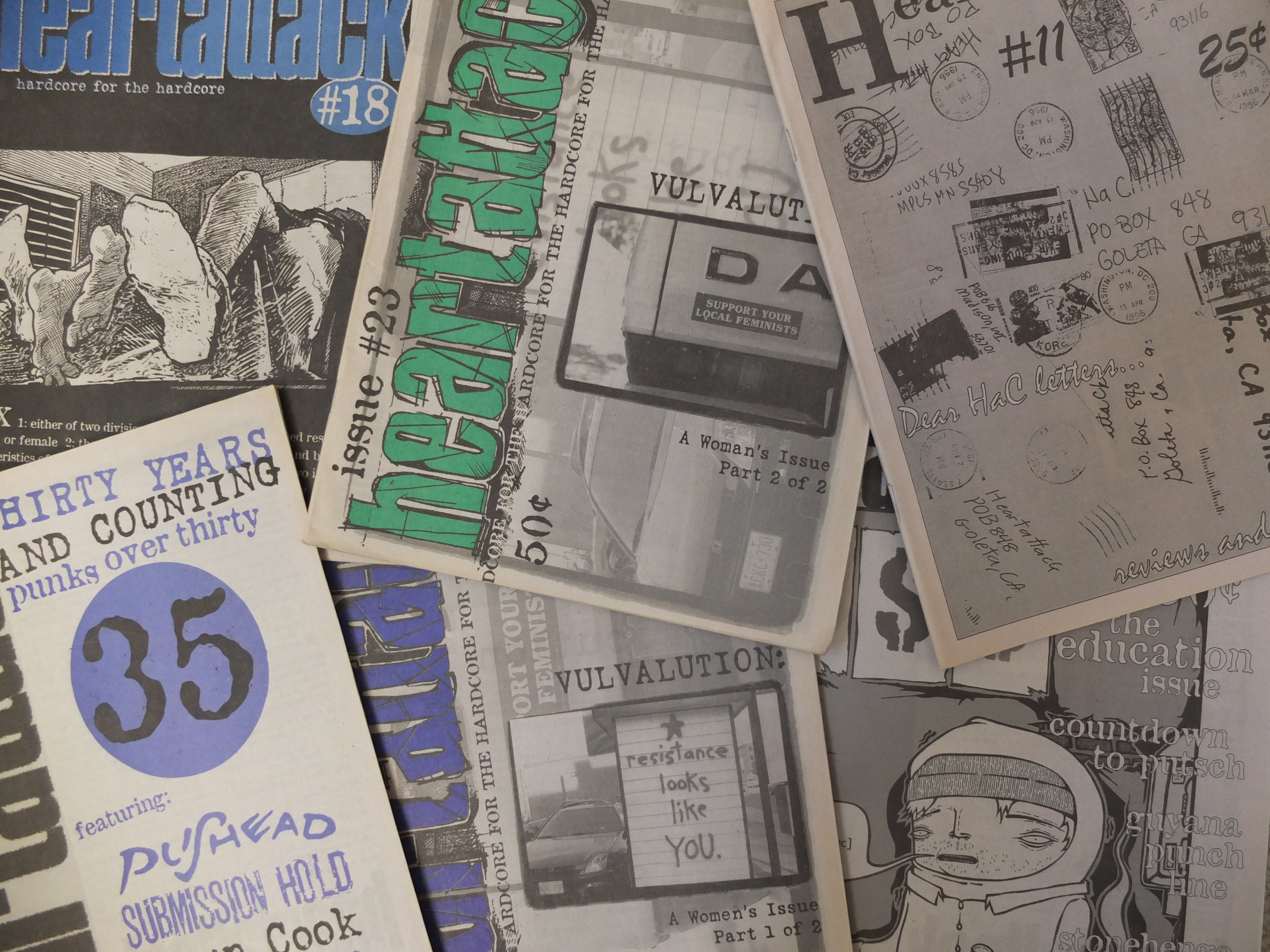
In the summer of 1999 the punk zine, HeartattaCk, released a special two-part issue focusing on feminism and women in punk (issues #22 & #23). Within these issues there is a compilation of letters to the editor and columns focusing on many different perspectives of the female perspective. Some writers focus of the female experience of punk, some on the music and production industries, however, an overwhelming amount focus in some part on their personal experiences with sexual assault and harassment. Although each story has individuality and should be understood as one woman’s telling of her vulnerable story, when looking at the amount of testimonies whether it is a story of rape or even a side story of harassment in the workplace, it allows the reader to see proof of just how common sexual assault really is. When I say “common”, I don’t mean as in “Yeah, it happens all the time, so?” I mean “HELLO?! There is a serious problem here! This isn’t coincidence!” HeartattaCk’s method for presenting these stories uses no censorship, no overarching theme or moral to the story, no judgement of the victim; just a safe platform for women and girls to share their experiences and create awareness or even just therapeutically write. This approach to sexual assault is tremendously productive as follows the concept of sharing testimonies in order to help other survivors or prevent sexual assault in general and I want to think about how HeartattaCk’s discussions of sexual assault can play exactly this helpful role, even reading these zines years later. A study on the benefits of blogging about sexual assault conducted by Hannah Fawcett at Manchester Metropolitan University found that
Reading narratives written by fellow survivors could help to validate and empower survivors by “normalizing” their own experiences, and several of the bloggers revealed that they had gained support and validation from fellow survivors as other victims could relate to the challenges associated with the process of recovery. (46)
HeartattaCk is designed to appeal to a punk audience and it feels just as rebellious as you would expect. Often times, feeling rebellious is empowering and makes you believe that you can say whatever you want without consequences. Although this is not usually encouraged in teens, sometimes it is necessary when trying to start a conversation that no one wants to admit they need to be a part of. One contributor to HeartattaCk #23 provides a perfect example of the empowerment. Vique M. writes with a tone of matter-of-factness that appeals to teens. This approach to talking about sexual assault allows teens reading this to feel as though they are a survivor rather than a victim if they have experienced sexual assault and if they have not then it can make the reader feel strength and the ability to stand up for themselves if it ever does. Writing like this opens up a conversation and a space for girls to share their experiences without the fear of judgment and instead with recognition of their strength and validation of their struggles:
Life is about choices, decisions and actions. You control them all. Things happen that are out of your control, but you choose and decide how to react to these things. Patriarchy is something that affects all aspects of our life. It is also something that we can react to in a million different ways. We can scream about it, cry about it, live with it, fight against it, etc., etc. We can lay down and scream or cry, play the martyr, or fight to destroy it.
If you are raped, you can let it destroy your life, or you can refuse to. If you suffer abuse, you can let it destroy your life, or you can refuse to. You can be angry and hate the world around you, or you can remain calm in the face of all of life’s adversities and try to be strong. There are so many ways to live your life. But strength is the most important quality that a person can possess. (35)
Vique M.
I was 15 at the time and I was going to a house party with some of my friends. I was so excited because I was NEVER, I repeat, NEVER invited to parties. I remember picking out the perfect outfit for the night Purple skinny jeans and a V-neck t-shirt that “showed off” my non-existent boobs. I got to the party and was completely overwhelmed. Showing up “casually late” for a high school party means everyone is drunk and “so happy you came!” I spent most of the night on a couch in the corner talking to my friends and holding a beer that I didn’t want to open. After about 2 hours of being there the party began to wind down and a game of truth or dare broke out. After a few rounds of the same question – “Do you like so and so?” – someone finally chose dare. She was one of the popular girls, not the one that people were always talking about but also not the one no one was talking about. She was dared to let one of the boys reach under her shirt and feel her boobs for 2 minutes. “She said “no” and got all embarrassed. Not the kind of embarrassed the other girls got when they half smiled and admitted they did like “so and so” but the kind of embarrassed when you’re vulnerable and so uncomfortable you want to disappear. The guy daring her told her that she had to do it “It’s truth or dare for God’s sake! Why play if you’re just going to back out on the first round?”. After about 5 minutes of pressure and harassing her, she caved. I got up and walked back to the couch to text my mom to pick me up, I didn’t want to play anymore. As I waited for my mom, I sat on the couch and listened to them in the other room. A quiet voice said “Has it been 2 minutes yet?” followed by “Time!” and the sounds of numerous high-fives. I remember the look on her face as she walked out of the room saying “my ride is here”. I felt sick for the rest of the night and I didn’t know why. It took about 4 years for me to realize that I had witnessed someone else’s sexual assault and didn’t know it wasn’t normal.
Why is high school such an important time for teaching about sexual assault and consent? It’s because teens are still learning how to navigate both sex and their social lives. The combination of these two account for a time filled with peer pressure. Teens are no longer going to listen to the “Sex Can Wait!” and “STD’s Kill!” posters in the hallways. Teens are now growing up in a time when sex is normalized and presented all over the media so it is not realistic to expect they won’t be having sex. The problem does not arise when teens become sexually active, the problem arises when they have no idea what a healthy sexual experience is. Teens tend to avoid talking about any sort of victimization they encounter whether it is with an adult or even with their peers. In her essay, ““You Just Don’t Report That Kind of Stuff”: Investigating Teens’ Ambivalence Toward Peer-Perpetrated, Unwanted Sexual Incidents”, Dr. Karen Weiss describes two theories as to why teens show ambivalence when they experience sexual assault. The first theory is that teens categorize their experiences through context. This means that if a teen is sexually touched against their will by a peer and not physically raped, then they may not see the event as serious enough to be considered assault or reported. This is the concept that these experiences are just “kids being kids”. The second theory is that teens never want to be the “tattle tale”. This theory relies on the fact that teens are always trying to fit in with their peers. This means that if a teen is told that there are social consequences to reporting an assault they will be less likely to report it.
Now how does punk conquer this? Instead of creating a social group that everyone must constantly police themselves to fit into, punk empowers individuals to be themselves and speak out when they need to without the consequences of being ostracized. In HeartattaCk issue #23, Carolyn H. exemplifies my argument perfectly when she recounts her story of sexual assault and concludes it by saying,
I am telling this story to provide an example of strength. I think we all need encouragement by example. Examples of revenge, of protecting female dignity, of ensuring lives devoid of fear. We need them now, when we are bombarded with images of physically weak women. The media manipulates us into thinking beauty means looking helpless and sick. (39)
This is the message that needs to be relayed to teen girls. The contributors of HeartattaCk are uncensored and free to say whatever they feel. This does not make them unruly and unfit to be examples of powerful women, it makes them real and relatable. Of course, in some instances language censorship may be necessary in order to be consistent with the North American school systems’ rules regarding profanity however, I suggest that this small regulation would not inhibit the messages and stories from being effectively communicated. The important thing is that through reading stories presented in this form, teen girls will feel free to share their own experiences and create a sort of community.
Sharing stories and experiences is crucial and what many people don’t realize is the commonality of sexual assault. In 2017, the #MeToo Campaign arose and although many people were able to open up and share their experiences with sexual assault, the campaign has almost completely disappeared due to backlash. Even though this campaign is struggling to survive, it still presented a very productive approach to the issue of sexual assault. Michelle Rodino-Colocino states that “By first connecting between counselors, girls, and young women of color, Me Too’s programing, counseling, and advocacy seek to equip girls with knowledge and skills they need to ‘thrive’ as sexual assault survivors” (97). I argue that this model can be broadened to include all women and eventually all individuals by demonstrating how common these experiences are and how victims are not alone. Similarly, in HeartattaCk issue #23, Rachel E. writes,
Why do I have to be afraid? I live under the same night sky, but such space separates us. Their figures walk behind me. Three young men, white baseball caps, same old story. And I think to myself how helpless I am. To be at the mercy of all you pass is to know fear. My body is weak. And what if something happens? What if I’m to be another statistic? What if I should have listened more carefully to their warnings, to not walk at night when I’m alone? I thought that was just something they said to keep women in the house. Bad things happen, but not here, not to me, or at least that’s what I once wanted to believe. And still they’re behind me. I wonder what it’s like to have one’s presence instill terror. Let the panic slip into me through all the crevices. I know someone should have walked me home tonight. I feel my vulnerability in every moment, in every menacing look, in every demeaning gesture, in the degrading words that have assaulted me. For this is my prison, to know that I will forever be hostage to this body, to this fear. Somehow, I’ve made it home again. I can only count it as luck that I’ve survived. Everyday I have to feel grateful that I’ve only been mildly victimized. Yet I can’t count on tomorrow; everyday l have to wonder if it will be me. (40)
Even though this account is not about experiencing an assault, it still communicates a common feeling that teenage girls as well as women in general regularly experience in North America. Testimonies like this demonstrate how all experiences regarding sexual assault are important including testimonies of the fear of being assaulted. The model used in punk zines does not only allow for conversation amongst victims but also conversation amongst women who view themselves as potential victims. I argue this type of conversation can allow for all teen girls to share their experience and in doing so, begin to work towards changing the stigma surrounding sexual assault.
Almost every North American woman can look back on her life and remember at least one sexual experience that caused her distress. I wish I had known – I wish I had felt like I could talk about it all. The uncomfortable first time and the terrifying fifth time. I wish I had known not to be ashamed. I wish I had known that it didn’t make me dirty or lesser or used up or broken. But now that I am much older and I know that there is more that could be done to prevent the sexual assault of girls who are the same 14-year-old girl that I was so that they don’t have to be the same 17-year-old rape survivor that I was. We need to tell our stories and more than that, we need to listen. We need to make it okay to ask for help and support without fear of cruelty.
This system needs to change and the new paradigm is Punk.
By Kyleigh Lampard
If you really want to get DIY with it, make the venue a safer space the night you are there. Put up your own transfriendly signs, put homemade bystander information cards everywhere, invite a local nonprofit that deals with racial injustice or gender-based violence to table next to you, bring an “official listener” or “peer listener” with you (someone who is trained in grounding techniques and can hand our resources if people need them during the night).
Shawna Potter
Making Spaces Safer: A Guide to Giving Harassment the Boot Wherever you Work, Play, and Gather
 Punk Pedagogy