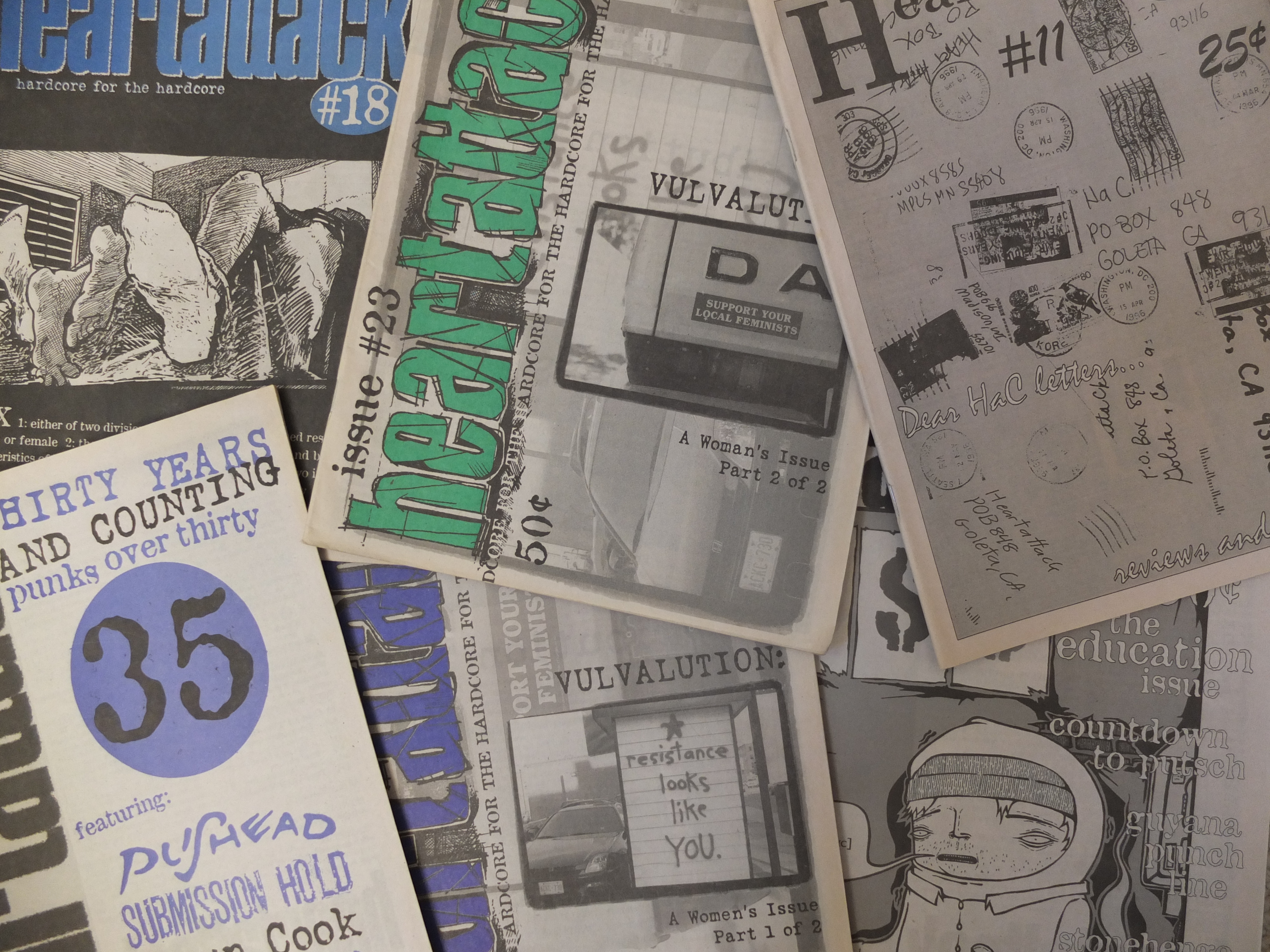
During a course about punk subculture, I became particularly fascinated by the central role that stories play within zines. Reading stories shared by contributors to HeartattaCk #22 and #23, I was impressed by women’s abilities to use punk as a space to share stories. Is storytelling a form of communal education within punk? Can storytelling enable women to educate one another while also inviting conversation? How might the stories told by women in the punk scene empower young girls and create a sense of community?
What follows is a consideration of the social function of storytelling in HeartattaCk. I hope to tell a side of the story of punk culture that is often overlooked and assess storytelling in a new way. Through this initiative, I hope to bring attention to how women’s stories teach other women how to listen and eventually learn how to share their own experiences within the punk space. Additionally, I will reference additional zines and academic works such as Vique M.’s zine Simba, Lauraine Leblanc’s Pretty in Punk (an academic book about women in punk), and an article about zine-making to further convey how storytelling operates as a practice of public pedagogy.
As a preamble, I think that it is important to acknowledge that a majority of the stories presented are not necessarily positive and pleasant. The stories highlight different experiences from each woman’s life – good and bad. I want to begin with Girl X’s story in issue #22 of HeartattaCk. Girl X shares her story of being a victim of date rape (46-47). She delves into the complications that followed after the toxic event and expresses how there are two sides to the story: Girl X believes that the sexual encounter was date rape, whereas the man suggests that she wanted it. She also dives into the kind of victimization she was exposed to because of the sexual encounter. Girl X uses storytelling not only to teach other women through her experiences, but also to teach life lessons that are relevant to women and men. Inevitability, the lesson within her story is the (strong) suggestion not to have sex with someone that is under the influence.
Girl X
In HeartattaCk issue #23, Girl X returns to this subject in a new manner. In this instance, she is responding to an anonymous man that has written into HeartattaCk sharing his regret having been the perpetrator of a date rape. Girl X responds to his letter by showing compassion for his willingness to admit that he has done wrong and is ashamed of his actions. Girl X, being a victim of date rape, thanks Anon for coming forward and admitting his mistakes. This reflects back on my earlier suggestion that the storytelling within punk is not always about the wonderful and beautiful parts about life, rather it is about sharing difficult and life altering experiences in hopes that someone else may gain insight. Moreover, storytelling becomes a means of exploring one’s emotions after a traumatic event. Directly and indirectly, storytelling acknowledges that events in one’s life inevitably affect others, just as they attest to the ways one is affected by the actions of others. Sharing stories can lead others to share their own unique stories.
By having access to a platform for storytelling, Girl X was able to connect with the anonymous writer in the subsequent zine. Girl X’s experience and response directly influence women by showing that there is a space that exists where women are able to discuss uncomfortable or provocative topics. The storytelling also enables women to strike up a conversation about the often avoided and taboo subject matters. These efforts help to provide a community of support for women, while also encouraging the continuation of sharing stories with other women.
HeartattaCk creates and provides a space to hear from both the victim and the perpetrator of two separate sexual assault cases. Moreover, the zine gave Girl X the ability to speak on behalf of herself and respond to the anonymous writer. In other words, storytelling within the punk space creates a platform for Girl X to discuss issues that are often overlooked, while also highlighting perspectives that are hardly ever shared – from the victim’s and the perpetrator’s perspective.
Simba
Oh, me, I’ll be okay, I have two people who really, really love me. And they make me strong and calm and able to cope. And I have a plethora of friends who have showered me with love and concern and care and support. But it doesn’t make it better. It doesn’t mean that I am not an orphan. It doesn’t make me whole.
Vique M.
I want to now shift the attention from Girl X to Vique M.’s stories within the zine called Simba. Simba has a strong connection to HeartattaCk in that Vique’s words appear in both zines (see the image to the right of the text). Like HeartattaCk, Simba shares provocative stories of sexual assault, sexual desires, and even family problems. Vique may not feel the need to expose every detail in her life but she understands that her words carry significance and can impact the life of another woman. The messages address everyday issues with sincerity and authenticity.
Her stories function as teachable moments that provide others with the opportunity to learn challenging life lessons. They do not shy away from telling the truth and therefore they teach important life lessons. No topic, story, or thing is ever “off limits” in zines. I would agree that nothing should be off limits because they are choosing to tell their own story how they want to: no censorship, no boundaries, and no restrictions. By featuring an individual perspective through the stories, it allows readers to understand a situation from a different perspective. The stories also allow readers to understand that each instance is unique, but being unique does not mean that one is alone and this is especially important for women. Women are able to gain a sense of comfort and connection by realizing that they have access to a community through storytelling. The wide array of topics throughout Simba sheds light on the imperfections of life and presents a realistic representation of experiences. The difficulties of life are inevitable, but sharing struggles, challenges, and successes through stories enables other women to gain a sense of support and community, while also educating readers.
My father hung himself 16 days ago. I am twenty-six years old and my parents are both dead. My mother dies of a heart attach on January the first 1995. My father couldn’t live without her and so he took his own life on June the 24th 1998. Life is fucking hard.
Vique M.
Pretty in Punk
After reading Lauraine LeBlanc’s Pretty in Punk, I realized that women did, and still do, convey their stories through a variety of different platforms. Pretty in Punk highlights the stories female punks share by conducting interviews; HeartattaCk focuses on personal accounts written by women. Both platforms address women’s stories and encourage these women to share their experiences, regardless of method. Leblanc’s decision to devote an entire chapter to women’s stories called “Subcultural Stories”, further acknowledges the importance and impact of storytelling. HeartattaCk carries the same initiatives by collecting written contributions from many punks. Here, women’s voices literally revolve around having the ability to share stories. HeartattaCk creates a space where women can share their own version of their story and where girls can read about women expressing their connections to punk.
Two examples from HeartattaCk issue #22 that take a comparable approach to Leblanc’s interviewees include Laura V. and Kate Cooties. Laura V. dives into the difficulties she has faced in life through trying to understand her childhood. She recalls the abuse that she experienced from her mother. She goes on to share that her mother discounts her memories and claims that the abuse never took place. Her mother’s refusal to acknowledge these events causes Laura to question her recollection and ask, “Did I simply misinterpret the past?” (HeartattaCk 43). Her abusive relationship with her mom has led her to struggle to differentiate what is true and false in her past. The story is authentic and raw, but beyond that, her story provides an education to other women. Laura recognizes that she struggles in her current life because of the abuse and lack of ownership on her mother’s part. Laura’s story functions as a warning to other women by highlighting the implications of abuse and what can come of it.
I found Kate Cooties’s story to have a similar function as the interviews within Pretty in Punk. In this section, Kate shares her struggles with what appears to be post-traumatic stress brought on by a car accident. She also divulges that a boy raped her at the age of thirteen. As her story moves forward, Kate shares that she befriended an “old school punk,” who she later learns has abused previous girlfriends. She eventually decides to leave the relationship behind after realizing his mistreatment towards past women.
This particular story helps to educate other women that they have the ability to walk away from toxic relationships; the story gives women a sense of empowerment.
Women like Laura and Kate share their experiences with other women in hopes that they will benefit from the lived experience and learned knowledge. HeartattaCk functions as a platform that features women using their voices to share a story – their story. These stories then become a text that can be used to educate women and promote the continuation of storytelling. This also goes back to the suggestion that the punk women willingly expose parts of their lives (the good, the bad, and the ugly) in an effort to teach other women; they put their lives on display in print in order to educate the girls reading and learning from their stories.
Inspiring Stories
There is a sincere relationship and bond that is created through storytelling between the woman sharing and their readers. As I read through these personal experiences, I immediately thought of a sibling relationship where the old, more experienced sibling shares their wisdom with the others. As Leblanc notes in Pretty in Punk, many “Punk girls repeatedly characterized their entry into punk as being an “adoption,” creating within the punk subculture a chosen family. Punk girls describe this family relationship as a sibling bond, referring to each other as ‘brothers and sisters’” (92). In my opinion, this sentiment properly conveys the relationship that is achieved through storytelling in HeartattaCk. These spaces give women the opportunity to share their own experiences with other women in hopes that someone else will find the information of use. They are optimistic that the female readership will learn from their stories and eventually decide to share their own experiences with the next generation.
I also think that there is an intimacy that comes through the interviews and stories expressed in HeartattaCk. It is irrelevant whether the story is about a good or bad experience, and instead the question is: can someone else learn from this experience? Can someone else be inspired by this experience? These women share their stories in hopes of reaching other women and helping them to be empowered, fearless, passionate, and stirred, as people and punks! They look at the experience not as a hardship that they have endured, but rather as a moment of teaching that they can pass on to someone else.
In HeartattaCk issue #22, Gracie B.’s story outlines the very ways in which punk zines have created a space that encourages support. Her story is a testament to the community that evolves from sharing stories in punk: “I was also able to find awesome ‘zines done by girls. ‘Zines that talked about being a girl in the scene but also got past the issue of being a girl and dealt with something else . . . The girls I was communicating with were really supportive and productive without making an issue out of being a girl” (49). Zines such as HeartattaCk have provided a platform where women are able to communicate and find support through storytelling in punk.
Contrary to common perceptions, Gracie shares that she has never felt excluded from the punk scene. Instead, she has found the ability to accept herself and recognize her successes through punk. It is as though she is trying to teach other women that the space is not as exclusive as the majority of people would believe. She hones in on the contributions that punk has had upon her own life:
“Not necessarily because others were supportive (although many people have been), but because I was able to be supportive of myself. I was able to see that I was and still am doing something positive, productive, and worthwhile” (49).
By expressing her perspective, Gracie shares that punk has given her the ability to see all that she is capable of. She emphasizes that what she has gained from punk far exceeds a sense of community, and filters into appreciating herself. She teaches other women to accept themselves by not only sharing her story, but also learning from her own experiences. She models the difference punk has made in her life so that others might explore their own relationship to the subculture. She shares for the benefit of educating other and for herself. The space serves as a reflection upon her words and promotes learning through a self-reflection.
Storytelling through zines inevitability creates a space for educating people by sharing new perspectives on the world. I began to think about zines through an educational lens after reading an article written by Kimberly Creasap, in which she discusses the various uses for zines in schools. I came to the realization that zines serve as a perfect primary source for young women to better understand themselves and begin to understand their own thoughts and opinions.
The purpose of storytelling within HeartattaCk does not end with encouraging self-reflection. Women’s stories in HeartattaCk serve a variety of purposes that include starting conversations, providing support, modeling ways of coping with challenges, and inspiring individuals to appreciate differences.
I think it is fair to suggest that the circulation of stories is equally as important as discussing the meaning within the stories. The women’s voices within HeartattaCk encourage readers to think, become educated, and continue sharing their personal experiences with others. Each voice within the zine reflects a woman that has willingly chosen to share her story for a reason. The messages can be used within an educational space to encourage discussions and to promote learning from the written experiences. HeartattaCk gives readers the opportunity to learn from someone else’s stories, they are given “permission” to discuss, think about, and question their own experiences. These spaces within zines allow women to learn about sexual assault like in Girl X’s story or a sense of empowerment and pride like Gracie B. shared. The focus of storytelling relies on the ability for women to share and learn from other experiences. The selection of stories that I highlighted from HeartattaCk showcase women using storytelling as not only an educational tool, but also provide women with a space to connect through storytelling.
Zines have the ability to sharing stories as a way of communicating and encouraging different opinions – political, controversial, and beyond. There is something unique and interesting that comes across through the stories taking shape in zines. The women’s experiences become more accessible through taking the form of storytelling in HeartattaCk. The contributors to these issues of HeartattaCk share their life lessons in an attempt to educate others. Where else can girls read about the messy, difficult, and uncensored parts about life? One of the amazing aspects of zines like HeartattaCk is their ability to not only share stories, but to share these stories in an effort to teach others and help them to learn about themselves and the world around them.
By Ashley Madson
We never thought we would be as popular as we turned out to be, and the support we were never expecting that, we just thought it was going to be more of a project kind of band.
But doing the songs in Spanish and being in the U.S. , you know doing stuff in another language we just didn’t think it was going to be very popular at all, and one of our main goals was to talk about the things we were experiencing, being from a different community. Where we come from is not a typically punk background or community – expressing our ideas in our language to young kids in our neighborhood. That was our main goal, and yeah, we did that and it went a lot further than we thought it would go, and it opened up different paths for us to take, to try and go with it, and a chance to take it beyond our neighborhood.
Martin Sorrondeguy, on the band Los Crudos, Maximum RocknRoll no. 192, May 1999
 Punk Pedagogy