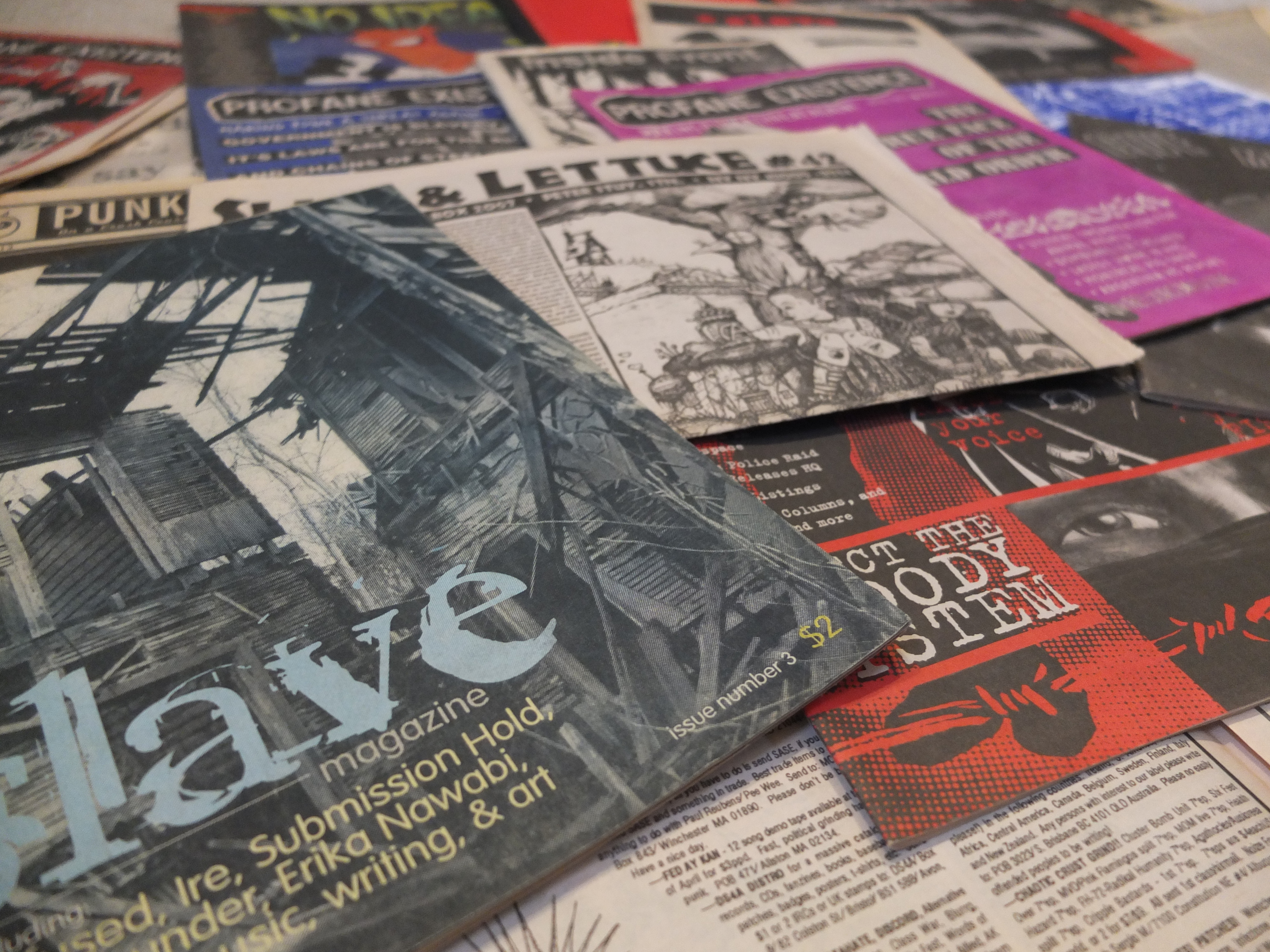
A description and assessment of several archives created by those within the punk community
Circulation Zero

Created by Ryan Richardson, Circulation Zero hosts complete digital collections of the following zines: Slash, No Mag, Damage, Dry, and Boston Rock. This is a fantastic collection of circa 1977-1984 zines that spans LA, NYC, Boston, and San Francisco.
While complete runs of fanzines like Touch & Go and We Got Power have been collected into awesome anthologies, many pioneering punk rags — the large format, newsprint ones in particular — are available only to dedicated collectors or packrats who’ve kept ’em since way back when. Not infrequently I’ve talked to fanzine creators and contributors who didn’t even hang onto copies of their own publications. While assembling some sets is doable with some moxie and spending cash, several runs border on the impossible even if you’ve got the drive and dough to acquire ’em. Digital editions are the only way most people will encounter these punk rags of yesteryear.
Access
Circulation Zero is one of the only punk archives that I know of that is thinking about how best to display zines as digital documents. Richardson notes that the flip page effects powered by flash animation he had employed previously on archiving projects do not operate on Apple-based products. He focuses on the user experience:
After originally uploading a zip file of JPEGs here on Circulation Zero, a consensus formed that a PDF would more useful. Instead of simply suggesting improvements, two guys just up and created PDFs and sent ’em over. … The downloads are now single, searchable PDFs which no longer require unzipping!
In order to address bandwidth issues, Circulation Zero hosts the complete run of each zine on Mediafire. As Richardson notes, it is helpful that these files are not zipped collections of PDFs, for the sake of security, because one knows what one is downloading.
There are potential drawbacks and/or additional benefits to this approach. It means that users cannot view the issues prior to downloading or select single issues, which may or may not be desirable.
Users are reminded by Richardson that this material is NSFW, or “not safe for work.” There are perhaps additional concerns about digitizing NSFW content and who has the right to not have this material re-surface online in searchable PDFs. Storing these zines as download links means that their contents are not searchable.
Copyright
The website does not explicitly address copyright but instead begins from the premise that zines belong to the community as much as they do individual creators:
Circulation Zero is an experiment, my attempt to “give back” by parlaying the preservation of some beloved punk publications into a greater good. My hope is that the original creators will not only enjoy seeing their work resuscitated but will also appreciate the fact that their work is helping generate donations to worthy causes. The site is also an attempt to answer some questions that bounce around in my head. Are collections better off inside institutional libraries or in the hands of collectors? Should ancient in-fighting prevent bringing the punk print hey-day to a new generation? Should eggshell walking over copyright issues cock-block oldsters from taking a whirl on the wayback machine? Can a world chock full of entitled interweb denizens be trusted to donate even a pittance in exchange for a treasure trove of never-before-digitized fanzines? I don’t know the answers but hopefully Circulation Zero will prove my hunches correct. Dig in!
Circulation Zero invites users to credit the website for material that is used and re-circulated.
Website
The website is a clean single page that is easy to navigate. Richardson invites users to donate to Doctors Without Borders or the Electronic Frontier Fund to show their appreciation.
Slug and Lettuce
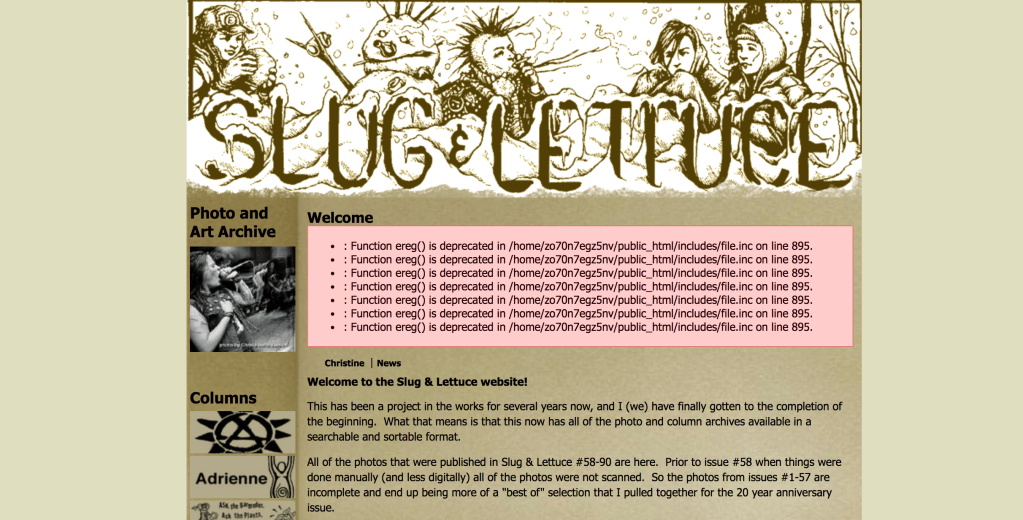
Slug and Lettuce was an essential zine started by Chris(tine) Boarts Larson out of NYC, know best for its unique folded newspaper fomart, ridiculously tiny print, excellent photography, and interests that crossed from Crust to Emo to Hardcore at a time when those sometimes separated out into distinct camps. Boarts Larson is the creator of this archive and as you can see from the screenshot above, the website may not be a steady focus anymore, given that some features of the website are generating error messages.
Access
The original Slug and Lettuce zines would be challenging to digitize. They were large newspapers with small print. They won’t fit any conventional aspect ratio and would require an almost industrial scanner. Rather than digitize the zines, then, Boarts Larson has transferred the content to the website, transforming the zine for this new medium.
This is damn impressive, but it does create some challenges sorting through material. If I select the columnist Adrienne Droogas, I automatically receive a column from Slug and Lettuce #76 from 2003. I can then scroll through a list of all other issues to read other columns. Except Droogas does not write in every issue, so it becomes a bit of a guessing game to find another of her columns.
The photograph and artwork section of the archive works a little better and one can generate results by issue, though not all issues seem to have content. I can sort by artist or photographer.
The reason for these gaps of content within the archive has to do with the original production of the zine:
All of the photos that were published in Slug & Lettuce #58-90 are here. Prior to issue #58 when things were done manually (and less digitally) all of the photos were not scanned. So the photos from issues #1-57 are incomplete and end up being more of a “best of” selection that I pulled together for the 20 year anniversary issue.
The next phase of the Slug & Lettuce archiving project will be to go back and scan negs to “fill in” some of the missing band photos from those earlier years.
Copyright
Given that the creator of Slug and Lettuce has created the archive, copyright is less of a concern. I would assume that she has permission to share the work of others in this new digital format.
Website
The website re-creates the feel of Slug and Lettuce in the sense that it has a clear artistic style and sense of purpose. It feels exactly right, recapturing many of the artistic cues of the original zine.
One of the features that I appreciate most about this archive is the introduction that Boarts Larson provides. Context is so important for a zine archive in order to understand what the zine was and what it meant to Boarts Larson. It also gives the reader a sense of connection with the creator of the zine, which is such an important feature of paper zines.
Digital Fanzine Preservation Society
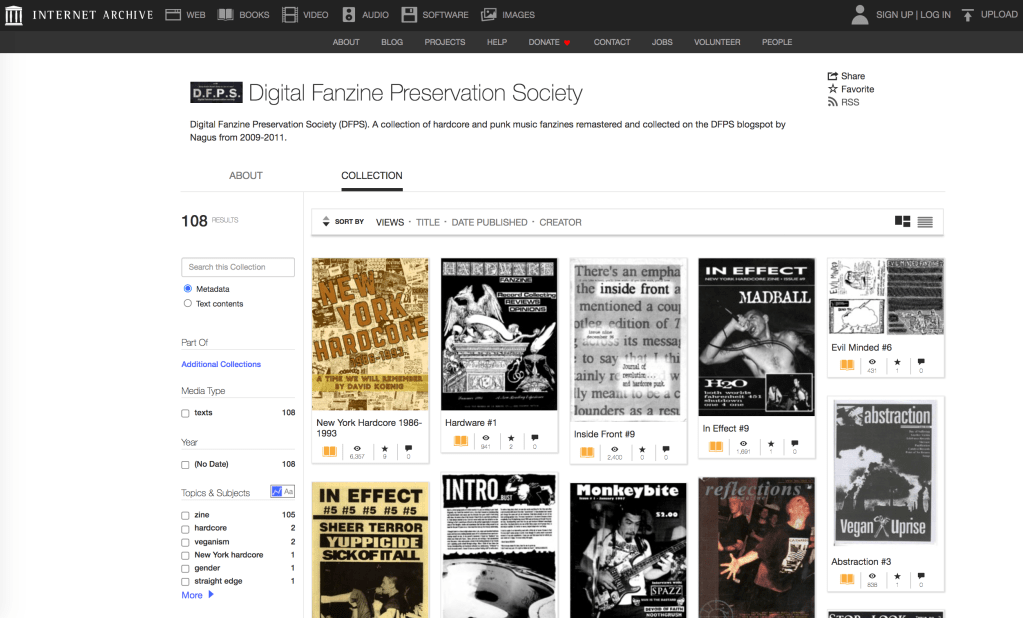
The Digital Fanzine Preservation Society – a name that is exactly as grandiose as its members are few, I would guess – started as a blogspot that posted PDFs of punk zines from the 1980s and 1990s. Rather than let that project go dormant, it has been moved to the Internet Archive so that these zines can be preserved permanently. The archive includes hard-to-find digital copies of Hardware, Quick Fix, Combat Stance, In Effect, Monkeybite, Inside Front, among others.
Access
Users can sort these digitized zines by title, date published, views, and archive. There are also topics and subjects to sort through which include: zine, veganism, New York hardcore, gender, and hardcore. There are also a group of collections that the zines are archived under but most zines are under the Digital Fanzine Preservation Society collection.
Each zine is clickable by the cover and then users can view the entire zine or download it. Issues load quickly. It is an accessible viewing tool where users can zoom in on the zine and make it full screen if they wish. The viewer is elegant and works on a phone as easily as it does a computer. There are download options available that include full text, kindle, PDF and a few other choices, which is impressive. The archive indicates if the PDFs are searchable documents that have been run through Optical Character Recognition. The number of views and folks who have “favourited” the specific zine are included too.
Copyright
Copyright is a bit of mixed bag, here. Helpfully, each zine archived on this website is designated with particular copyright terms that tells users what permission they have to distribute the zine. For example, the usage guidelines for the New York Hardcore 1986-1993 zine identifies the document as belong to a Creative Commons license in which
You are free to:
Share — copy and redistribute the material in any medium or format
The licensor cannot revoke these freedoms as long as you follow the license terms.
Under the following terms:
Attribution — You must give appropriate credit, provide a link to the license, and indicate if changes were made. You may do so in any reasonable manner, but not in any way that suggests the licensor endorses you or your use.
Non Commercial — You may not use the material for commercial purposes.
No Derivatives — If you remix, transform, or build upon the material, you may not distribute the modified material.
No additional restrictions — You may not apply legal terms or technological measures that legally restrict others from doing anything the license permits.
What is much less clear is the basis on which this license is established. Nowhere does the Digital Fanzine Preservation Society indicate if and from whom permission has been given to digitize this material.
Website
The format and software /hardware provided by the Internet Archive makes this an elegant and smooth functioning website that is easily navigated and visually appealing.
Inside Front Archive

Crimethinc describes itself as an ex-workers’ collective and Inside Front was a zine created by individuals who would develop and sustain Crimethinc. The website hosts digitized copies of the zine. Rather than read like an archival project, this website expresses the spirit of Inside Front by making these zines available to a new generation:
Once upon a time, in another century—
When only doctors and lawyers had cell phones, and long distance calls were so expensive that punks used hacked phone dialers to trick pay phones into letting them place calls free of charge;
When zinesters secured freedom of the press by scamming photocopies on a scale today’s social media users cannot imagine;
When traveler kids sneaked onto freight train cars to ride for free, watching mountains and oceans whizzing by as the earth rumbled past beneath them;
When the singer of every hardcore band spoke earnestly to introduce each song, if only to entreat audience members to cause each other serious injury;
When punk itself was not an ossified tradition, but a living challenge to corporate aesthetics, in a process of constant challenge and change;
When DIY bands traversed a network of squatted social centers from Trondheim to Santiago, and you could play a hundred shows in a row without ever performing in a venue that was legally owned or leased;
When dropouts lived on bread alone in order to dedicate themselves entirely to lives of daring adventure;
When MAXIMUM ULTRAISTS committed to risk-tolerant experimentation organized guerrilla noise shows in convenience stores and mashed pies into the faces of corporate entrepreneurs;
When young people inspired by punk music set out to reclaim the streets and destroy the World Trade Organization, and everyone understood that anarchists were among the foremost threats to capitalist globalization;
In those days, without the internet, how did people discover and pass on anarchist ideas and tactics?
By embedding these values in rebellious subcultural milieus such as the punk scene—by reading dogeared books about the Yippies, the Situationists, and the Spanish Civil War—and by having adventures.
These three elements—subculture, reading, and adventure—came together in the hardcore journal Inside Front, one of the first projects to bring together people who still collaborate on CrimethInc. projects today. We invite you to explore its pages, as if holding a candle up to the dusty walls of the past.
Access
Issues 11-13 and a postscript are digitized and available for download. The original zines are pretty substantial and these digital files are colour PDF files that can take some time to load. Many of these zines came with compilations on CD and these have been digitized and made available once again at https://crimethinc.bandcamp.com/
Copyright
Because the zine is being disseminated by its original creators, copyright is less of a concern. Add to this Crimethinc’s anti-copyright policy, and this is even less of an issue. I do not know how they are handling permissions from contributors who are presently involved in Crimethinc and this decision to archive zines digitally.
Website
The archive is a single page on the Crimethinc website and each individual issue is available as a link.
MaximumRockNRoll Archive

MaximumRockNRoll is the longest running punk zine in existence, with over 400 issues dating back to 1982. In 2016 they started a project to archive the zine and place its unparalleled physical collection of punk music and ephemera on a firmer archival footing.
We maintain and preserve the largest archived collection of punk vinyl in the world (more than 46,000 pieces, and counting).
MRR is a physical archive and is building a digital record of its music holdings and a digital archive of the MRR zine.
Since announcing plans to create a digital archive, it has been an object lesson in how challenging it is to archive material at this scale. There is no firm timeline on when these zines might be archived and available publicly, though some of the reviews from early issues are now available on their website. More information about that can be found at https://maximumrocknroll.com/new-reviews/
New issues of MRR are born digital and will be available online moving forward.
Access
Articles and reviews are fully accessible online for born digital issues. I wish that issues had a table of contents to create a sense of what each issue offers. I am not sure it makes sense to call these “issues” anymore; it is maybe more accurate to say that MRR is now a website that serves the punk community with monthly interviews, articles, columns, reviews of zines and music, and a weekly radio show/podcast. One doesn’t really read an issue; instead one navigates content posted to distinct categories.
Copyright
Because they are creating their own archive, this will address many of the potential copyright challenges associated with digitizing zines publicly. I do not know how they plan to handle the rights of individual contributors or if the presumed copyright will rest with the publisher/zine.
Website
The website is clear and visually compelling, carrying a nice punk preference for stark black and white elements. Navigating is not always intuitive or simple, however, and I routinely found myself having to google things to find them effectively.
Essential Ephemera: UK Punk Literature and Images 1976-1984
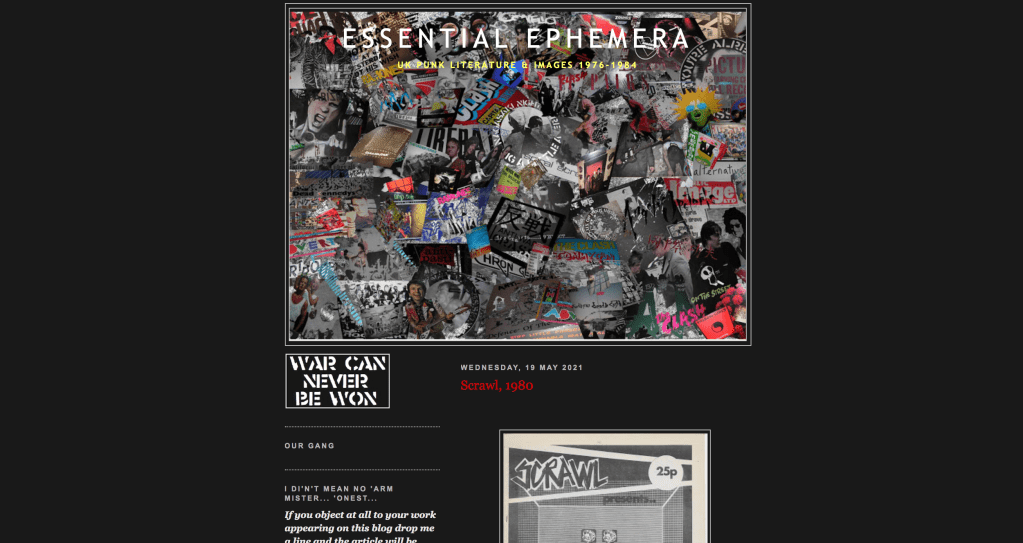
Essential Ephemera is more D.I.Y. than Digital Fanzine Preservation Society. It is a blogspot that has been archiving UK punk ephemera for more than a decade, including zines and posters. Updates to the website have been dwindling during the last 5 years.
Access
The Blogspot is set up in a typical blog format where there is a dated post with an image and description attached at the bottom. To the bottom right of each post is a link where users can download the zine from MediaFire. Unfortunately, many of the links are now dead. The zines are categorized by year and month along the left column of the website. There is no search function.
Copyright
Rather than address copyright concerns, the website offers the following notice:
if you object at all to your work appearing on this blog drop me a line and the article will be removed immediately and sincere apologies proffered.
Individual zines contain some discussion of rights as well. For example, the zine Anti Climax #1, 1979 description title read: “All his stuff is copyright so don’t rip anything off ok?”
Website
The Blogspot format offers a useful structure when one is following the site in real time and receiving updates. As an archive, it is difficult to browse because one can only do so by opening up the tree of dates on the left hand of the screen: one selects a year, then a month, and then discovers the post titles for that month. Rinse and repeat for 5 years, and 12 individual months, potentially, in each of those years.
Queer Zine Archive Project (QZAP): Zine Archive
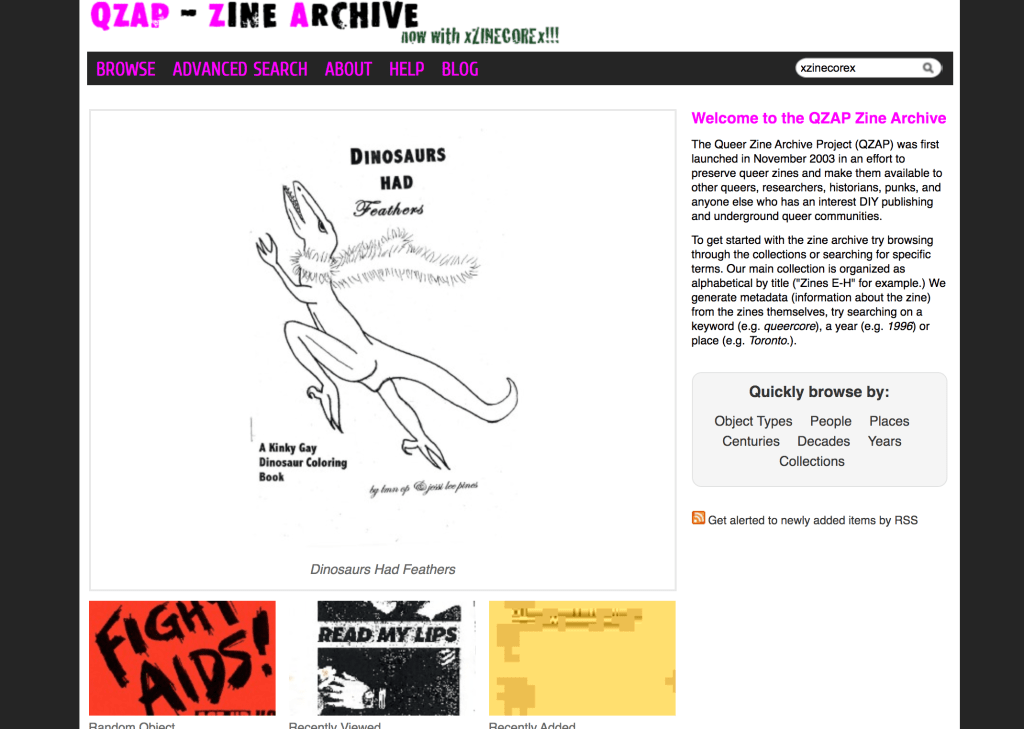
The Queer Zine archive was started in 2003 to preserve zines pertaining to queer culture and “make them available to other queers, researchers, historians, punks, and anyone else who has an interest DIY publishing and underground queer communities.” As they describe themselves:
The mission of the Queer Zine Archive Project (QZAP) is to establish a “living history” archive of past and present queer zines and to encourage current and emerging zine publishers to continue to create. In curating such a unique aspect of culture, we value a collectivist approach that respects the diversity of experiences that fall under the heading “queer.” The primary function of QZAP is to provide a free on-line searchable database of the collection with links allowing users to view or download electronic copies of zines. By providing access to the historical canon of queer zines we hope to make them more accessible to diverse communities and reach wider audiences.
Relevant to the question of what punk zine archive collects, the Queer Zine Archive Project has a substantial and developed collection policy that specifies how they decide if something is appropriate to the archive.
Access
Zines are digitized and are available immediately within a PDF viewer on screen. Zines can also be downloaded. Zines are described with clickable tags and keyword searching is available as well. On the homepage is the montage of zines, and three categories below that are titled: Random Object, Recently Viewed, and Recently Added. To the right there is a section that is titled Quickly browse by… and provides quite a few options which include: object type, people, places, centuries, decades, years, and collections. Quickly browse by section is the most helpful because users have the option to explore different options. The site redirects users to a space where they can scroll and browse their chosen category easily. Users can have multiple filters at once to hone in on their interests. In general, QZAP have clearly anticipated that users may search this content and have made it possible to do so in a variety of ways.
Copyright
On their blog, the Queer Zine Archive Project notes they their reproductions are covered by “fair use” and educational exemptions. They also try to contact creators where possible to obtain permission; unfortunately, there is no public record of when something is posted by permission to the archive and when that permission is presumed under “fair use”.
Because of the nature of zines, many of the materials are presented to the public as Anti-Copyright, Copy-Left, freely duplicatable, or more recently in the Creative Commons. Often zines are donated to us with the express purpose of digitization and reproduction. When we come across material that we believe fits into our archive we also perform due diligence as best we can in terms of contacting original authors and creators to ask permission to include their work in our archive. If you come across your work on the QZAP website and would like it to be removed, please contact us.
Website
The QZAP website is clean and functional and navigating the collection is easy and direct.
By George Grinnell and Lea Sebastianis
The way we danced in New York was different than the way they danced in Connecticut, was different than the way they danced in Minneapolis, in D.C., in Southern California. And now you can go on tour and everybody’s going to do the exact same thing. The crowds will pretty much look the same. There’s nothing that’s unique to that city. I do think that’s a new development. Especially in terms of underground and punk-related scenes.
Norman Bannon
From, Anthology of Emo, Volume 1
 Punk Pedagogy