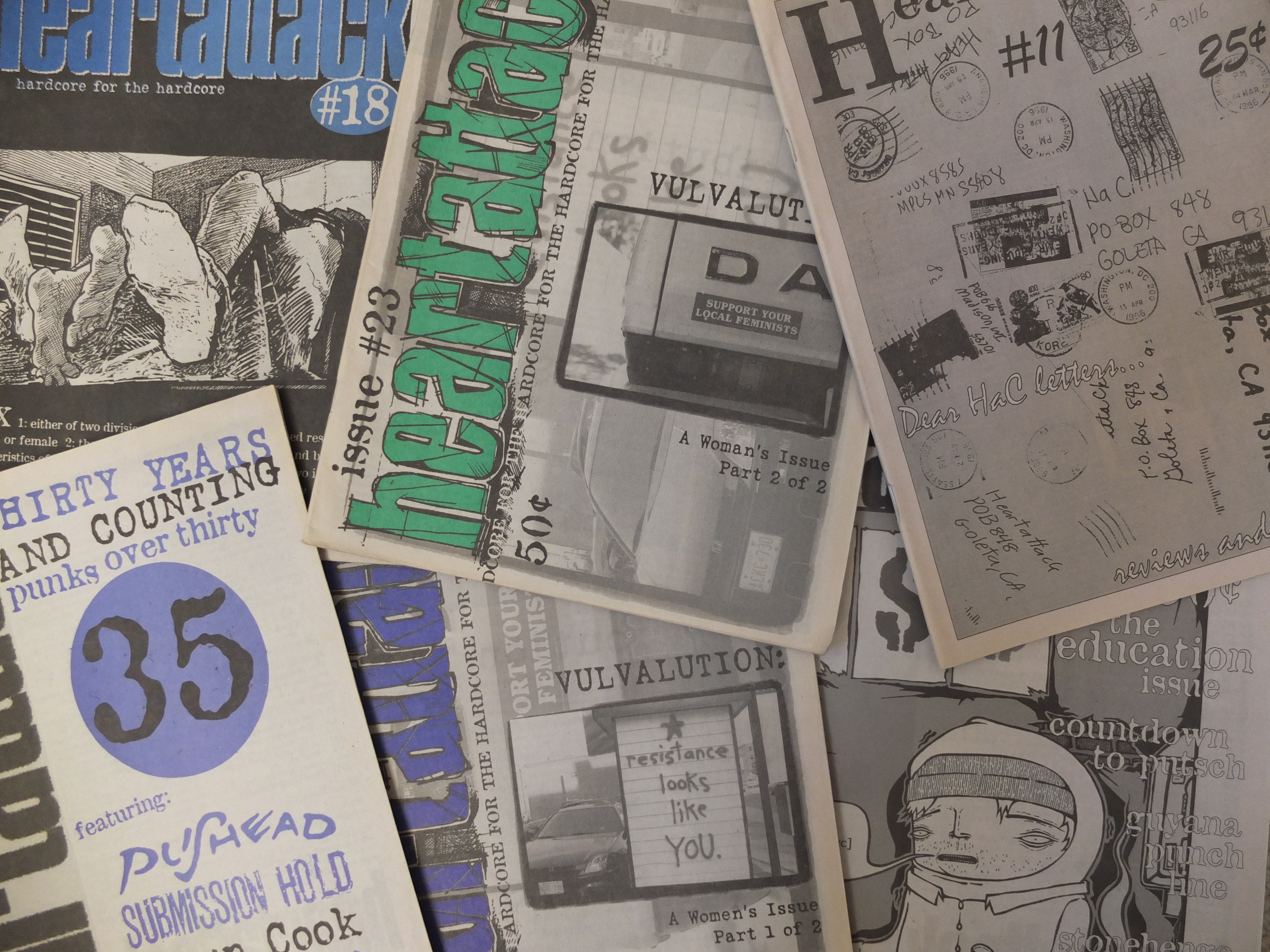
Listening to punks over 30
1.
I want you to think about punk culture, and all that it possibly entails: the music, the clothing, the venues, the people and the lifestyle. Now, I want you to think about an individual punk. Why did you think about him in the way that you did? When asked to think about a specific punk without any guiding questions, the most commonly recognized images of what a punk ‘is’ becomes who is pictured. More than likely, a young white man in a costume of sorts, like spiked hair, a studded leather jacket and torn jeans. These commonly associated symbols became recognized, and maintain the recognition, of what defines someone as ‘punk.’ Yet these symbols, recognized as they may be, aren’t applicable to some groups of people within the culture, just as recognized symbols of any other culture aren’t applicable to every member belonging to it. This is especially true for punks over the age of thirty; even if punks are stereotypically young, and even though there is likely some truth to the stereotype.
The problem is when we let the stereotype render some lives unrecognizable, as if it were impossible for a punk to be thirty, forty or fifty years old. As a child whose parents frequently took him to concerts by seventies and eighties bands, it became a joke to try and find someone younger than myself in attendance. There never were many other eight, ten, or twelve years old concert goers, and as such I was often on the receiving end of jeering ‘do you even know the words?’ or ‘what do you think they’re singing about?
Just because I was young didn’t mean I wasn’t connected to the songs or to the build-up before an encore, just as it didn’t mean I was oblivious to weed or how to avoid a mosh I wasn’t interested in joining. In much in the same way, the contributors to HeartattaCk’s August 2002 issue thirty-five “Punks Over Thirty” advocate that their age doesn’t limit their connection to punk scenes, the culture or their own punk identity, and that how they are seen by the culture is disconnected with how they portray themselves.
2.
Punk is and has always been a culture dominated by youth. As such, being recognized as ‘old’, works against an individual. Rather than being a punk, they are seen as an ‘old’ punk; rather than being seen as a record producer, they are seen as an ‘old’ record producer; rather than being seen as who they are (‘such-and-such’), they are seen as ‘such-and-such, the old person.’ This is not to say that punk is ageist in nature and the contributors to “Punks Over Thirty” appear to advocate otherwise. It is to say, though, that punk is a culture with inherent values, beliefs and traditions that are governed, often, by a majority of its members that are regularly under the age of thirty and, as such, finds its ‘inherent’ factors relatively in line with their ideals. Because of this young demographic’s influence within punk culture, the contributors to this issue of HeartattaCk challenge the status quo of punk as a youth culture by showing how adulthood and their punk values coincide, and how there is no justification is recognizing them as ‘not punk’ because of their age.
3.
As the group seemingly on the margins of punk culture, the contributors to issue thirty-five of HeartattaCk question their position and initiate a discussion regarding age in punk by highlighting how those over the age of thirty have come to be recognized. The thirties have always been the pension age for punk. However, reading some of the letters from the “Over Thirty Years and Counting” section of the zine shows that this is no longer the case. They actively demonstrate how they have been able to incorporate punk into their adult life, and how having a prototypical ‘adult’ life, or aspects of such, does not inhibit their ability to be still be punk. Many of the contributors describe actively going to shows and supporting bands, both that they had always supported and those relatively new.
It is punk culture, not them, that assumes that thirty is the inevitable age when punk is replaced with owning a Volvo and a time share in Palm Springs.
Really, some of the punks over thirty already have most of the adult stuff: a home, a business, a car, a cell phone, insurance, a retirement plan, a college degree—really square boring stuff, that allows them to sustain their lives while continuing to live alongside punk and incorporate it into their adulthood.
But, having these things in no way excludes them from being members of the culture. Instead, the contributors show that, for many reasons, they are still connected the punk culture and still sympathetic to punk even though the majority doesn’t seem to recognize them as such.
4.
In “Punks Over Thirty,” the contributors show how they recognize themselves and explore how that differs from how they are recognized by punks in general. Those differences can cause problems between the over and under thirty groups. Punks over thirty tend to be seen in ways that reduce them to their age and thus lose significant features of their identity and tend to homogenize them with others on the basis only of age. Recognizing a group of people based purely on anticipated aspects of being a certain age, as a homogenizing force, eliminates all individuality. Being defined as ‘over thirty’ implies an inherent connection with everything typically associated with being ‘over thirty’ throughout history, as if becoming that age meant you shared experiences with all other people who had ever experienced the same age. The fact that the contributors all live distinct and unique lives – some with a house and a business, some with a partner and some without any typical ‘adult’ amenities – immediately begins breaking down social assumptions about age.
5.
Understanding how punks over thirty are recognized by their subculture is only a portion of the issue.
Imagine, for a moment, that you’re walking on a path (be it a trail, a sidewalk, campus, the parking lot at work, wherever it is you normally walk) and you fall. After standing up and ‘dusting yourself off,’ you look around to check if anybody had seen you trip, and find nobody except for: a sparrow, perched nearby, who is noticeably looking at you. How does it make you feel? Even though it wasn’t specifically another person, someone saw you fall—saw you in a way you don’t want to be seen. In a similar way, the contributors to “Punks Over Thirty” consider how the culture recognizes them and considers it as something they don’t necessarily want to be seen as.
Just as you, more than likely, don’t want to be seen as someone who trips and falls, they express how they don’t want to be seen as ‘too old’ to be punk. More poignantly, from reading their opinions and reflections on the culture, they work to show that being recognized primarily as an age distorts how their actions and movements are perceived. Attending a show to see a band becomes waiting to pick up their kids, and once inside, being uninvolved in the mosh is assumed to show that they are not supportive of or interested in the current music.
6.
In many respects, punk is most commonly associated with a disenfranchised youth and as such is viewed specifically as a youth culture, or a youth movement. However, in HeartattaCk, punks thirty years and older show that this idea is only partially, if at all, true. In terms of people at shows, yes, it is primarily a youth movement and will probably stay that way. Overall, though, punk is a widespread culture with people of all ages involved. Some of the most passionate contributors to the scene may be the ones who have been in the scene the longest are in a position to teach other and help to instill some of the core values, practices, and strategies of punk culture.
Punks over thirty are adding a new dimension to the experience of the punk culture by discussing the aging process and asking to be recognized differently; they are modelling a different way of recognizing the aging process in punk. Punks over thirty are teaching younger punks how to age with the scene but continue living their punk ethics and values without conflict, rather than only in tension with adulthood.
They are showing that it is possible to have a typical adulthood with a nine-to-five job, house and family while still being involved in punk scenes, at shows and in the culture, without having to choose between the two. They do not show us what it looks like to lose one’s links with punk, but what it looks like to incorporate their punk ethics and values into adulthood and how to age while maintaining them. Additionally, though, they show us that aging does not mean aging out of punk, but that those who think punk ends at the age of thirty are clinging to a conventional idea of adulthood that will persist unless how they recognize aging and punk is changed.
7.
I was speaking with a classmate of mine who was explaining to me how she understood what the columnists and contributors in “Punks Over Thirty” discussed. She explained to me that, in her interpretation, they were speaking about being saddened by their position: they no longer felt connected with punk because of their ‘adult’ lives; but still weren’t connected with ‘adult living’ because of their history as punks. I understand that interpretation, yet, I disagree with it. I find that these punks over thirty aren’t saddened by a lost connection with punk but are (amongst other emotions) sad with the realization that punk no longer thinks they have a connection with punk. Rather than lamenting that their age causes an inability to still be punk or participate in the scene, they argue against being recognized as ‘old’ punks, or even not punk.
They haven’t stopped being punk; punk has stopped seeing them. Punk needs to recognize them as the punks they are.
The culture, the scenes, the members under the age of thirty – what needs to be rethought, needs to be discussed, needs to be unlearnt, is how those members over thirty are recognized: age first, their presence in the scene later. Because they are still present in the scene, and they remain as such for multiple reasons that their age has no bearing on; namely, that they are punk.
By Tyler Fey
I made it out alive because two things happened in my life. Punk opened the door to mental health awareness, but I had to make the choice to walk through that door. I love that punk opens doors to great things. And it is my dream to see punk push people to walk through those doors and get help for their issues.
reid Chancellor
Hardcore Anxiety: A graphic Guide to Punk rock and Mental Health
 Punk Pedagogy