By George C. Grinnell
Published in Punk, Ageing and Time, a collection edited by Laura Way and Matt Grimes
A PDF is included at the bottom of the page
Enduring Attachments: On the Temporalities of Punk
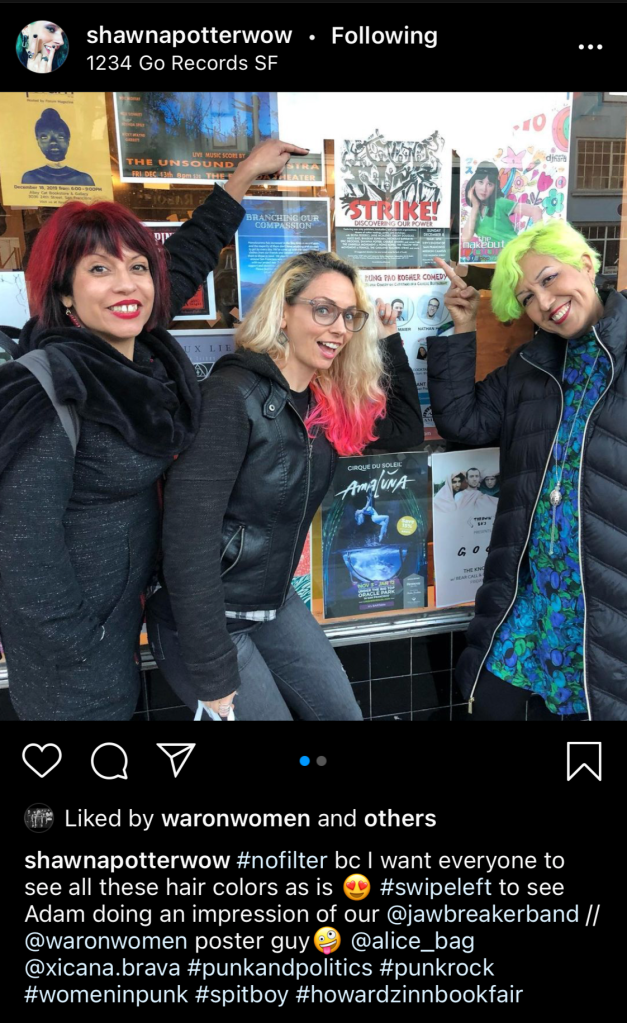
There was a picture on Instagram of Alice Bag, Michelle Cruz Gonzales, and Shawna Potter together in 2019. It is a joyful image of three generations of punk women in the United States whose musical heydays are often categorized as belonging the 1970s, the 1990s, and the present. The image is notable for more than just capturing three pioneering women from three different eras of American punk. It illustrates several commonplace but not always recognized features of punk: women have always been central figures; people of colour have always been vital participants; punk has always been more of an attitude and an allegiance to a DIY ethos than a fixed sound; and what was once a youth subculture has developed a variety of ways of thinking about the enduring attachments that some have with punk.
The image was taken at 1-2-3-4 Go! Records in Oakland and while these women are known for being musicians in bands such as Alice and the Bags, Spitboy, and War on Women, they are also authors who have written about punk. This chapter examines some of their writing as a way of posing questions that hover at the edges of this photo. How are their experiences of punk similar and different? How do relations of power within punk shape the accounts they write about punk? How do their narratives reflect on the the reality of ageing in punk and ideas of temporality that express a desire to change punk in the present?
In Violence Girl: East L.A. Rage to Hollywood Stage, A Chicana Punk Story (2011), Bag narrates her experiences growing up and becoming a founding figure in L.A. punk in the 1970s. Gonzales offers a quite different experience of what it means to be a person of colour in punk during the 1990s in The Spitboy Rule: Tales of a Xicana in a Female Punk Band (2016). Shawna Potter addresses the end of the 2010s with Making Spaces Safer: A Guide to Giving Harassment the Boot Wherever You Work, Play, and Gather. While her book is not a memoir but an activist manual that seeks to empower individuals to make punk a safer space, it makes explicit many of the themes central to the discussions of power and inequality that inform the narratives by Bag and Gonzales.
In different ways, each of these narratives reflect on what it means to live in the wake of the disappointed ideals of punk, a story that becomes clearer with age, in some cases, and rawer in the moment of telling, in others. While these women write about distinct periods in the history of punk, they each reflect on gendered and racialized relations of power in punk and do so from the perspective of individuals who remain attached to punk and what it can yet become. Their narratives assess the past and intervene in the present by telling stories that can reshape punk. This means that this chapter examines something not quite visible in this photograph: a concept of temporality that lies beyond the familiar chronologies of punk history and beyond the personal memoir and accounts of one’s salad days. What kind of punk temporality is it that emerges out of their continued attachments to punk culture and their desires to document the past while also reshaping what punk is and means for individuals in the present and future? As Bag, Gonzales, and Potter show, the reality of ageing and reflecting on one’s continued attachment to punk can shift ideas we might have about punk and its temporality, including when it happens, its lifespan, effects, and what the stories we tell about it might do to shape the future.
Although two of these works involve life writing, my focus is not memoir and genre, though there is certainly much that one could say about such matters. Instead, my focus is on what unites each of them: they are a trio of works that make visible some of the relations of power that have long structured punk.
As such, these books contribute to histories of punk women and add an important qualification to that project with their shared consideration of time, circumstance, and experience, especially for Xicana women, as well as the attention they bring to white male privilege in North American punk and its uneven dominance (Bag, 2012; Nguyen, 2011; Griffin, 2012). These authors write themselves into a project documented by Helen Reddington regarding the prominence of women in punk that begins in the 1970s in the UK. She sees this period as “an important historical moment when women instrumentalists established themselves in an influential new rock music genre” and seeks to rescue “this moment from the amnesia of conventional popular music historiography in the same way that other ‘histories from below’ have been written about the achievements and experiences of other excluded or marginalized social groups” (Reddington, 2016, p. 194). This chapter extends such research in two ways. First, it explores how temporality and femininity have been braided together such that one cannot think one without the other, given that there is no chronology of punk without the story of the gradual hostility directed toward women and the substantial barriers that had to be overcome to participate “in male identified music” (p. 194). Second, the chapter recognizes that the marginalization of women is part of an uneven and never fully successful movement to normalize white, heterosexual, male privilege in punk. As Michelle Phillipov notes, if punk is understood as “an essentially positive progressive movement articulating egalitarian, community-based, broadly leftist politics” that resists dehumanizing social relations under capitalism (2006, p.386), this perspective cannot be neatly reconciled with the marginalization of women, queer and transgender people, as well as people of colour in punk. These works insist that any chronology of punk must acknowledge such unpromising realities even and especially when they challenge a redemptive narrative that celebrates the impressive accomplishments of a DIY spirit and anti-establishment punk politics.
These works offer more than just an account of ageing in punk. They mediate how punk ages, then, and contribute to a body of criticism concerned with the narration of what punk is. More, they actively intervene in the maturation of punk by exploring areas of its history that have not always received the attention they deserve. Punk began as a youth culture and it has an uneven relationship with ageing. It celebrates immaturity with claims like “we are the kids” (in a song of the same name by In/Humanity) and often appreciates crude exploits over polished outcomes in sound and design. Such attachments to a cult of youthful exuberance are themselves a kind of lived theoretical exploration of “how that transition to adulthood is a culturally constructed social phenomenon” (Davis, 2012, p. 118) that takes the from of a daring departure from maturity. One could fairly wonder if immaturity has since become a dominant feature of politics and culture in many of the places where punk first flourished. Punk rock’s obvious antagonism toward that “adult crash” that has meant the topic of ageing is often unthinkable: what follows after youthful punk adventures comes to be represented primarily as death or an abdication of one’s punk ethics. The recurring declarations that punk is dead, for example, express this anxious refusal to let punk age and mature. If one is a punk, one is a kid. To become an adult is to leave punk behind.
Such an equation is not the whole story. Punk was sometimes the most mature kid in the neighbourhood; it had to be to get away with some of the shit it tried. Kids created entire networks to distribute music and tour; they learned to live without consuming animals in a culture hostile to animal ethics; and they hosted shows in venues they created themselves because they wanted to express themselves and their culture. Such activities don’t happen if one is childish and immature. DIY takes commitment and coordination and a serious-minded approach. Such passionate dedication and practical habits age well and it not surprising that many have remained part of punk throughout adulthood. Laura Way (2019) notes that “what punk means to older punk women” (p. 258) is defined less by the gravity of music and more by the “core punk values . . . such as DIY and community” (p. 268). Ross Haenfler (2012) similarly explores how punks come to practice ideals “professed in their youth but lived in adulthood” as they age (p. 23). Bennett (2006) comments that one of the features of ageing punk is an increase in “the variety of practices through which individuals retain a commitment” to punk (p. 223). Bag, Gonzales, and Potter each exemplify how punk is “reworked to fit across time, rather than being clearly situated in one moment of a person’s life” (Davis, 2012, p. 106).
The stories told about punk often acknowledge its interest in “a range of political and social discourses in a concrete and immediate way, but it is often ignored that it was marginalized groups who contributed this vital factor and provided the necessary enrichment to allow punk to be more than just another youth style dominated by white, cisgender, heterosexual men” (Lohman and Raghunath, 2019, p. 190). Punk’s “countercultural and political credentials were almost entirely dependent on these [marginalized] groups who defiantly confronted and dismantled stereotypes and were crucially and, often for the first time, visible not only to a wider culture but more importantly also to each other” (p. 190). It would be tempting to reply, as some do, that “much of punk history and criticism has been written by people who weren’t there at the time” and that what is needed are first-hand accounts from individuals who are in the “unique position to describe punk as I lived it (and still do) as well as provide a forum for others who were there to share their stories and perspectives” (Bag, 2012, p. 233). But there are plenty of oral histories, memoirs, and narratives of punk that forget the lives of marginalized punks, precisely because those oral histories listen to only some voices. Bag, Gonzales, and Potter suggest a further consideration when one thinks about the stories we tell about who has built and sustained punk culture: punk is now shaped by a curious temporality in which the present is partially a product of still-evolving accounts of its past. I will discuss this temporality more soon, but I want to first explore some of the primary aims and effects of these books.
Alice Bag is a founding figure in the LA punk scene in the 1970s and Violence Girl tells the story of her youth growing up in East L.A. and her life-altering experiences in a punk community that was creative, sustaining, destructive, persecuted, and eventually transformed by the emergence of hardcore. She was the lead singer of The Bags, a group known for performing in sexually-provocative outfits and paper bags over their heads. Bag was also a founding member of the iconic feminist punk band The Castration Squad. Writing as Alice Bag, not Alicia Velasquez, the memoir raises many fascinating questions about the more and less performative nature of identity, matters that lie beyond my focus on this occasion. For now, I will simply note that I am guided by Bag’s decision to refer to herself by her punk rock stage name.
Her story is a familiar one in the genre of punk memoirs and for good reason because DIY has always been among the most compelling origin stories of punk. Bag (2011) recalls being inspired by the first punk show she witnessed, a bill that included the Zeros, the Weirdos, and the Germs, with the Damned in attendance: “it was as though someone had taken a torch to all of our ridiculous fears and self-imposed limitations” such that “everything and anything was possible” (p. 183). “All we needed was the guts to try” (p. 183), Bag recalls, because that night “Mexicans, Weirdos, and teenagers with more courage than musical skill could take the stage and bring the house down,” kicking the establishment “off their gilded thrones” and “it was us – the rabble – who were going to do the kicking” (p. 183). Not only was punk transforming music, it was a “cultural revolution” affecting “everyday activities, from what we consumed to what we produced, from what we believed to what we found improbable” (p. 194). As Bag puts it, “punk was changing us from the outside in” (p. 194).
The Bags started “because two good friends dared to dream of having their own all-girl band” (p. 325), even if the band would eventually emerge with an even gender split among the four members. The title of the memoir recalls a song by The Bags entitled “Violent Girl,” a reference to Bag’s willingness to throw down with the boys in an effort to police violence against women at concerts: “my protective instincts went into high gear and my fists were swinging before I could think about it” (p. 234). As Bag notes, this rage was a response to threats to “my new home and my new family” as well as an expression of ongoing domestic abuse that was part of Bag’s childhood (p. 235). Such aggression on stage meant that she “was often accused of being too masculine in my performance… too violent, too in your face for a girl” (italics in original, p. 221). Some had “never seen a woman so angry” and punk was upending norms of gender and power (p. 308). The revolution was temporary, however. Bag’s memoir ends by noting how the landscape of punk in L.A. “was changing before my eyes” (p. 308). Punk was receiving more attention from outside than ever before. It was subject to state violence as police invaded punk clubs in full riot gear. These events were familiar to Bag as a racialized person in L.A.: “I’d sensed this danger many times before; I’d grown up with it all my life. It was the plight of the defenseless in the face of unrestrained power and force. It happened in East L.A. when the L.A. County sheriffs gunned down Chicano activists” (p. 304). And the revolution of punk was being policed from inside as well: “The once quirky men and women artists who prized originality above all else were being replaced by a belligerent, male-dominated mob” at concerts, changing the tone and spirit of punk (p. 309). Gone was an ideal that celebrated difference: the rallying cry of “the more variety the better” was being drowned out (p. 303). “Early punk was as much a rejection of the status quo as it was the product of the rejects of the status quo,” Bag (2012) elsewhere writes, appreciating that “we were a band of misfits” for whom there “was no white, male hierarchy” (pp. 236–237). Looking back more than thirty years later with age and perspective, Bag sees that early punk in L.A. represented a temporary loosening of social norms that was compromised by the rise of those same discriminatory relations of force that had policed her life as a Chicana woman growing up.
The freedom from norms of race, sexuality, and gender that Bag associates with punk in California was short lived and, over the next two decades, punk in the United States continued to become increasingly male-dominated, even if that led to sometimes thoughtful conflicts between sensitive and aggressive masculinity. As Gonzales explains in her memoir on this era, punk had learned to perpetuate many of the discriminatory norms that defined the world it claimed to oppose.
Gonzales was the drummer for the seminal all-female hardcore band Spitboy, and her memoir chronicles these days as a member of a band writing music that was “tough, and vulnerable, and it had attitude” (Gonzales, 2016, p. 128). The Spitboy Rule is especially notable for the story it tells of her place within the East Bay (Oakland and San Francisco) hardcore scene as both a woman and a Xicana. To create “something totally fresh and new, like the female punk band I had been waiting to hear, waiting to discover for some time” was a rare achievement for women at this moment in punk (p. 128). The scene had become dominated by men, even if its commitments to masculinity were sometimes ambivalent, and starting a “band that would soon be named after a female-body-centric creation story, a story that didn’t involve god, a rib, or a man” was radical (p. 129). To do so and also forcefully declare their independence from Riot Grrrl during the height of its ascendancy as a female-focused sphere of punk culture was quite another. Riot Grrrl emerged in 1991 and was associated especially with scenes in Olympia, WA, and Washington, DC. It challenged the marginalization of women in punk with a generation of exclusively female bands such as Bratmobile, Bikini Kill, and Team Dresch alongside a vibrant zine culture. Spitboy sought to carve out a separate path by remaining attached to hardcore and insisting on their place within that male-dominated scene rather than identify with Riot Grrrl. As a memoir that revisits these tensions, the book reminds punks in the present of the variety of ways that one can address inequality and appreciate diversity.
Despite their impressive performances, national and international tours, positive reception, prominence in the surging DIY punk scene of the 1990s, and support from prominent labels such as Lookout, Allied, and Ebullition, Spitboy was often received as an exception first, a band that was good considering they were women. As Gonzales notes, Spitboy did not always receive “the same respect [men] gave each other” (p. 23) and comments like “‘You hit hard for a girl’,” became a predictable assessment of her drumming. Capturing the spirit of Gonzales’ immediate desire “to punch each guy who said it in the face” (p. 31), The Spitboy Rule is a sustained middle finger to punk sexism. Gonzales documents the triumphs, joy, and life-changing experiences of “playing what everyone thought of as male music” (p. 23) with talented female artists who “genuinely liked one another and admired one another in many ways, too” (p. 55).
The memoir celebrates the rare achievement of a dominant all-female punk band in the 1990s and recognizes how needlessly difficult that was. More, it levels powerful critiques against expressions of punk feminism that harmfully promoted colour-blindness by ignoring the “relative comfort and white privilege” some experienced. Such feminism had little to offer a Xicana woman “who grew up in a small town, who was raised by a single mom, and who had been raised in relative poverty” (p. 19). Gonzales explores how her Xicana and punk identities did and did not converge, noting that people saw her as a woman only and that meant “people in the scene did not see me, who I really was at the core, the face and body through which I experienced the world” (p. 90). While I can only imagine how much this book must mean to Xicana women in the punk scene today and tomorrow who will find they are not alone, Gonzales knew just how transformative such a realization could be. Spitboy would release a split LP with Los Crudos, Latino punks from Chicago who were “one of the most beloved hardcore bands in 1990s” who sang “about Latino issues in Spanish” (p. 117). Not only was the “scene’s enthusiasm for Los Crudos … an indirect form of personal validation” (p. 119), it also meant no longer going it alone, even when surrounded by her white female bandmates. Gonzales notes that their record, Viviendo Aperamente (Roughly Living), explored “Latino struggles and feminist struggles” and “the cover image of a woman who looked like me felt like a personal victory” after “spending so many years feeling invisible” in the punk scene (p. 117). Age and experience give Gonzales perspective and The Spitboy Rule documents a seminal band and recognizes the vital contributions of the author at time when Xicana women were not being acknowledged in punk. One of the continuing legacies of the memoir will be the effects it can have upon future generations who will know they belong here and are following in the footsteps of others like Bag and Gonzales who have gone before them.
The Spitboy Rule ends with an account of the pleasure of writing their first song and discovering who they could become as women together in punk culture. “Seriously” was a “simple, three-chord song” that spat back all the rage that followed from “a night two guys in a visiting punk band sexually harassed me at a party at my house” (p. 128). The realities of misogyny in punk had been long ignored by the subculture and these are the conditions that Potter has set out to address and transform with her book.
Potter is the lead singer of the feminist punk band War on Women, and her guidebook is a road map to putting feminist philosophy into practice in punk. It establishes frameworks to make punk culture, and ultimately anywhere else that depends on sociability as a binding agent, more hospitable especially to women, people of colour, queer and trans individuals, people living with disabilities, and others who have faced discrimination within spaces that are not always as counter-cultural in practice as they proclaim to be. Making Spaces Safer, started off as a zine and a set of workshops that Potter shared during tours. She writes for those hosting a “house party, basement show, art opening, punk club, community space” as well as “festival, scene” in order to make just about any “space where people gather” safer for those who experience discrimination for being who they are, including one’s sexuality, gender, race, and ability (Potter, 2019, p. 10). The work is guided by the idea that whatever else punk does, it is fundamentally social in the sense that it exists as an effect of human interaction and occurs in spaces that can be structured by unequal relations of power whether by intention or neglect. As Bag noted, punk could create safer spaces for marginalized individuals, and Gonzales recognized that it often did not.
Potter’s book is obviously different from a memoir and while it might not tell a story about a life lived in punk, it is clearly motivated by the personal realities faced not just by Potter but by too many women in the punk scene. If one of the rhetorical effects of memoir is to invite the reader to identify with and reflect upon the personal experiences of the author, Potter achieves a similar degree of intimacy by beginning from the assumption that she speaks not just for herself but for many more who have found that punk is not as safe a space as it could be.
Potter writes with a mix of pragmatic utility – there’s a template for a “Punk Club Conflict Resolution Plan,” for example – and an encouraging tone that, in the tradition of the best zines, speaks directly to the reader, wondering “were there any bits that just didn’t click, that you were hesitant to listen to? Congrats! Now you know where your weak points are and can address them. Do what you can, then figure out how you can do more. Keep a steady pace and take care of yourself” (p. 172). Potter situates her efforts within a broader history of the development of safer spaces during gay liberation and feminism, noting that the goal is not to create spaces “free of challenging ideas or different opinions” but to recognize the existence of discrimination and then “doing what we can to ensure [those facing discrimination for who they are] are believed and supported if it happens on our watch” (p. 11). Potter quotes Ren Aldridge from The Petrol Girls who survived sexual assaults at house shows in London: “We need safer spaces to make it easier for everyone to organise politically, and also for us all to have a fucking break sometimes” (p. 18). The book embraces a punk ambition to build “a better a world inch by difficult inch” (p. 38) and that means recognizing the complexity of discrimination within “truly DIY spaces” that offer “no legal protections or rights” (p. 56) as well as in “small social scenes where most people know one another” (p. 55). Potter makes inspiring and direct connections between the anarchist safety precautions that gave rise to the tagline “ask a punk” on fliers in the case of gigs held illegally, on the one hand, and the need to exercise a similar degree of care at a show, on the other: “just because the law doesn’t know you exist, doesn’t mean you can’t help validate the existence of everyone who walks through your doors” (p. 57). Recognizing the power of artists to shape the venues that host them, Potter encourages bands to ask if venues have policies in place to make a space safer and then explain why it is important “that your audience feels safe and welcome at your shows” and/or “make the venue a safer space the night you’re there” by inviting relevant local organizations to set up and share their info, creating trans-friendly bathroom signage, and ensuring that a merch person is trained in bystander intervention and crisis response (p. 67).
Potter’s book recognizes that punk is not juvenile anymore. But its maturity is inconsistent: “if our goal is a less violent world, focusing on the positive change you can make locally is a perfect place to start” (p. 70). Potter shows is that ageing in punk is not just a personal experience; it is a social experience that involves taking responsibility – whether one should have to or not – for changing punk and bringing it closer to many of its stated goals of equality by realizing what it takes to actually transform relations of domination.
One way to understand how these three books reflect on ageing in punk would be to fit them into a chronology of disappointed ideals, a story that perhaps becomes clearer the longer one is attached to punk: Bag looks back to celebrate the diversity of early punk in which Latinos and women were central participants; Gonzales recalls how that earlier paradise was lost; and Potter depicts an organized feminist response designed to recover some of the equality glimpsed by early punk. These three works are united by their common commitments to feminism and anti-racism, as well as their understanding that punk can be transformed by the work of dedicated individuals, whether that means making venues safer or by telling one’s own story and insisting that these experiences matter to the history, and present, of punk rock. Each of these works see that punk is a community that can transform lives in ways that are positive or harmful. These works believe in the vitality and promise of punk and I would speculate that their authors would not go to all of the effort to write books were they not still attached at some deep emotional level to punk, regardless of how large or small a part it might play in their present daily activities.
These works express an enduring attachment to punk despite age and a continuing desire to alter it with one’s written contributions in the present. Ageing is not, in these works, a reflection on what it means to be a punk in one’s thirties or forties or fifties or older. Ageing is an unspoken context evident primarily in how these authors remain attached to a social experiment called punk, taking the time and effort to document it and shaping what it can yet become for the future.
Bag, Gonzales, and Potter each illustrate how the recent surge of works remembering punk can reshape the present in ways that are more just and equitable based on whose stories are told and what topics are recognized to matter. These works see that cultural memory is always more than just a matter of recording what happened. There will always be multiple stories to tell and different ways to narrate the past. Whose voices dominate? Whose experiences are acknowledged and prioritized? When these works demand that women and women of colour be remembered and recognized as participants, they also recognize that writing can alter the future of punk by embodying “the potential for producing inclusive spaces” that was sorely lacking in DIY punk scenes in the early 2000s despite the fact that “equality [was] often verbally promoted and sexism condemned” (Griffin, 2012, p. 76). Each of these authors take responsibility for stewarding the culture and this is a particular expression of ageing that diverges from what Bennet (2006) describes as the practice of older punks who “positioned themselves as critical overseers of the local punk scene” in order to judge “the scene and those involved in it” (p. 228). Bag, Gonzales, and Potter are not standing in judgment, as if looking from a distance. They are actively shaping punk by sharing narratives that expose relations of power within punk culture, using their accounts of punk to make a case for imagining alternatives that have existed or could yet exist. They use personal experience to express the full emotional impact of dehumanizing relations of domination in punk and make the case that things need to change.
Their books remember the vital contributions of women and people of colour, something sometimes sorely lacking from recent public expressions of memory. As Francis Stewart (2019) notes of the 2016 exhibition at the British Museum celebrating the 40th anniversary of punk’s emergence: “notable, largely by their absence in the content of the exhibit, were references to women, disabled people, people of colour and LGBTQIA individuals. Punk was never solely the domain or identity of white, cisgendered, able-bodied, heterosexual men” (p. 211). Leslie Kahn—one of the editors of the zine HeartattaCk—made a similar point during the 1990s:
I constantly hear about the lack of women in punk, and the lack of active women, but there really are a ton of active women doing so much stuff. There may not be a ton of women in bands (though there certainly are several), but since when is punk supposed to be all about the bands? There are many women currently kicking ass doing so many things, and there have been many women in the past to for inspiration (Martin, 2012, p. 193).
As Griffin (2012) notes, “women play more central roles in activities that are less visible when analysing the spatiality of a show” (p. 72) and this is especially clear in the zines that make up the “community institutions” of punk culture (Duncombe, 2008, p. 53). One might conclude, then, that it is a commitment to community and a desire for a better world that motivate Bag, Gonzales, and Potter.
But their books do more than just tell new stories about who matters in punk. More than just documentation, these books can do things. They can generate effects, thicken and thin out alliances, stir and prompt, and act upon readers in unpredictable ways. I am interested to close by speculating upon one of the primary effects of these works: the idea that punk is being shaped and reshaped by new forms of temporality that are emerging in works that bring the vitality of 1977 and 1997 and 2017 into the present, merging all of these moments and making them simultaneously available to punks now. For a punk in 1988, there might have been some local lore about the scene and a few record labels with back catalogs. Now one can read memoirs about so many different experiences of punk!
The temporality mediated and created by these books and works like them is distinct, I think, from frameworks of ageing and the perspectives that emerge as an author grows older. That latter approach to ageing was evident in my earlier consideration of how these authors take stock of some of the failures of punk to upend the status quo. Likewise, that same approach to ageing was present in a special issue of HeartattaCk entitled “Punks Over 30” that documented and explored the presence of older punks in a culture once thought to be only for kids; and ageing is similarly front and centre for a band like Done Dying (2013) that proclaims they “are done with the notion that my time has passed” despite being made up of middle-aged punks.
The temporality of these books names another matter, even if grows out of the realities of ageing and punk. In this context, temporality involves asking when does a book affect people and with what duration? These books bring the past to life for punks in the present, inspiring new possibilities, while also belonging to a time that has passed. There is a temporality to punk – the many ages of punk – that is not exactly the history of punk because it is living and changing according to new gravitational forces established, for example, by that photograph and its novel alignment of different individuals who may never have been in one another’s orbits when they first entered punk. It is not just them but also me and their works and their substantial catalogs of music and performance that gets pulled into some sort of alignment here. There is an organizing temporality that emerges when we read these books together that does not exist in the same way when they are apart. Punk temporality recognizes that the narratives one tells can change what we know of the past and alter punk for future generations. This temporality has forcefully emerged as something that can dissolve or firm up distinctions between the past and present and future. For Bag, the temporality of punk involves one in what is more than punk:
In the process of writing my memoirs, I discovered that I was able to situate my participation in the birth of the West Coast punk scene within a much broader historical context, one that was not at all obvious to me at the time. What started out as a series of autobiographical blog entries ended up telling the story of several social movements that personally affected me: the Chicano movement, feminism, gay rights. My particular form of punk expression was also deeply affected by my childhood. I was born in East L.A., the daughter of Mexican immigrants and I entered the U.S. educational system as a non-English-speaking student. (2012, pp. 234–235)
The story of punk is never just the story of punk, a reality that each of these women document so effectively and painfully as they confront relations of domination and inequality that do not belong to punk but which are nonetheless intensified by punk culture. To speak about the temporality of punk is to abandon clean distinctions between what is and is not punk, as well as where it starts, ends, and restarts.
This strange temporality in which the pastness of punk is created in the present (and the present is shaped by the past) can change the essence of punk, then, now, and for the future. Temporality involves recognizing the continuing changes and effects wrought by the knowledge contained in these narratives. Directly, in this instance, this means moving “marginalized groups within punk” onto the stage so that they are no longer “fetishized strangers” (Stewart, 2019, p. 214). I can’t underscore this point strongly enough. The history of punk is women’s history. The history of punk is the history of people of colour. These books do not add new voices; these voices have always been part of punk. It is the weird effect of sustained efforts to forget their contributions that makes the temporality of all of this so curious. These books feel as though they are adding something to the punk archive. That is what this temporality involves: it is a restoration that feels like an addition because the chronology of punk is being played out of time.
A punk temporality captures some of the complex co-existence of relations of domination in punk scenes that aspire to equality and seek to end dehumanizing social relations. These contradictions are visible in new ways, as if in the form of simultaneous punk timelines: misogyny and the centrality of women; the whiteness and diversity of punk, unsafe spaces and much needed spaces of inclusion. Punk has always included the marginalized; punk has never been safe. These contradictory realities are true and they can exist in the same time and sometimes even the same place. Temporality is not chronology. It is not then and now. The story is not always linear and definitely not always progressive. One does not want to forget the differences between then and now, but a punk temporality makes it possible to offer another insight beyond the workings of chronology. Consider these comments from Reddington, writing on the substantial role of women in punk:
Finally, for all of the women I spoke to, punk was about individual freedom and self-expression above anything else, and it is the importance of this factor that is lost in many of the texts written after the fact. Hindsight shows up many of the flaws in the ideology of punk, but its protagonists were, in the main, sincere in their activities, and no amount of academic misinterpretation can deny them this. (2016, p. 169).
Reddington offers a fair defense of the individual desires that structure punk. But defending punk like this may not change its future. The punk temporality present in works by Bag, Gonzales, and Potter offers another possibility in which one need not defend the past and its sincerity any more than one would need to attack it. These narrate their own experiences as the first step to altering what we expect, demand, and imagine punk could be. They remain attached to what is so promising and empowering in punk even when the past says it would be foolish to continue to believe in such ideals.
The strange temporality of punk is evident in other ways too, such as the digital mediums in which recordings and zines from another time and place live on in all sorts of unpredictable ways, sometimes carefully curated and sometimes not. This may be an intensification of what recording and printing as always meant for temporality. To speak about Gonzales as an older punk hardly makes any sense when one can listen to her perpetually youthful drumming on any Spitboy record. And what does it mean to listen to a 2021 remastered recording of something from the 1990s? What kind of magical transformation of the past is this? Punk temporality does not even end there. Listening to that “Mi Cuerpo Es Mio” 7” now, the first Spitboy recording I ever heard and one of my first punk records, it sounds different. And it is different, at least for me. It is different because I hear different things in it now, because I know more about all of these musicians, and especially the drummer. It is different because I am different too. Perhaps it is even different because my hearing has changed over time, the consequence of too many loud shows or not enough of them depending on your moral calculus. It is different because I know how much it meant to Gonzales to title the record in Spanish and claim her identity as a Xicana in a scene that failed to acknowledge her. And punk has always been punctuated by getting to know one another, at least for me. When I met someone or saw a band live, it changed everything about how I listened to their music or read their zine. What is punk if it is isn’t this strange experience of time travel in which past activity transforms present experiences and vice versa?
Finally, I will end with one last example of punk temporality, drawn from Bag’s account of her band Cholita, fronted by the drag queen Vaginal Davis, from the 1980s. Being backstage “at a Cholita performance is a bit like seeing a bomb explode in a drag queen’s closet” with costumes everywhere. The elaborate performance makes a simple point about punk and its strange temporality that makes “kids” out of us all (2011, p. 378). Davis insisted “that every member dress the part and adopt the persona of a teenage Latina, the more colorful and over the top, the better,” leading to chaotic performances with a “message of social and sexual equality behind the mascara” (378). And isn’t this a perfect representation, in part at least, of what punk is for anyone who ages with it, a way of being a little bit young – immature, even – at the same time that one grows older, still holding out-of-step ideals and working, always working, toward a more just world with all the knowledge and tactics that one picks up along the way?
References
Bag, A. (2011). Violence Girl: East L.A. Rage to Hollywood Stage, A Chicana Punk Story. Feral House
Bag, A. (2012). Work that Hoe: Tilling the Soil of Punk Feminism. Women & Performance: a journal of feminist theory, 22(2–3), 233–238. https://doi.org/10.1080/0740770X.2012.721079
Bennet, A. (2006). Punk’s Not Dead: The Continuing Significance of Punk Rock for an Older Generation of Fans. Sociology, 40(2), 219-235. https://doi.org/10.1177/0038038506062030
Davis, J. R. (2012). Punk, Ageing and the Expectations of Adult Life. In A. Bennet & P. Hodkinson (Eds.), Ageing and Youth Culture: Music, Style and Identity (pp. 105-118). Routledge
Done Dying (2013). Anthem. Shelf Life. Reaper Records
Duncombe, S. (2008). Notes from the Underground: Zines and the Politics of Alterative Culture. Microcosm
Gonzales, M. C. (2016). The Spitboy Rule: Tales of a Xicana in a Female Punk Band. PM Press
Griffin, N. (2012). Gendered Performance and Performing Gender in the DIY Punk and Hardcore Music Scene. Journal of International Women’s Studies. 13(2), 66-81
Haenfler, R. (2012). ‘More than the Xs on My Hands’: Older Straight Edgers and the Meaning of Style. In A. Bennet & P. Hodkinson (Eds.), Ageing and Youth Culture: Music, Style and Identity (pp. 9-23). Routledge
Lohman, K. & Raghunath, A. (2019). Notes in the margins. Punk & Post-Punk, 8(2), 189–192. https://doi.org/10.1386/punk.8.2.189_2
Martin, V. (2012). Simba: A Collection of Personal and Political Writings from the Nineties Hardcore Scene. Vitriol Records
Nguyen, M. (2011). It’s (Not) a White World: Looking for Race in Punk. In S. Duncombe & M. Tremblay (Eds.), White Riot: Punk Rock and the Politics of Race (pp. 257-267). Verso
Potter, S. (2019). Making Spaces Safer: A Guide to Giving Harassment the Boot Wherever You Work, Play, and Gather. AK Press
Phillipov, M. (2006). Haunted by the Spirit of ’77: Punk Studies and the Persistence of Politics. Journal of Media and Cultural Studies, 20(3), 383-393. https://doi.org/10.1080/10304310600814326
Reddington, Helen. (2016). The Lost Women of Rock Music: Female Musicians of the Punk Era. Routledge
Stewart, F. (2019). ‘No more heroes anymore’: Marginalized identities in punk memorialization and curation. Punk & Post-Punk, 8(2), 209-226. https://doi.org/10.1386/punk.8.2.209_1
Way, L. (2019). ‘I don’t go to the gigs to go to the gigs – I don’t give a shit about the gigs!’: Exploring gig attendance and older punk women. Punk & Post-Punk, 8(2), 257-269. https://doi.org/10.1386/punk.8.2.257_1
 Punk Pedagogy