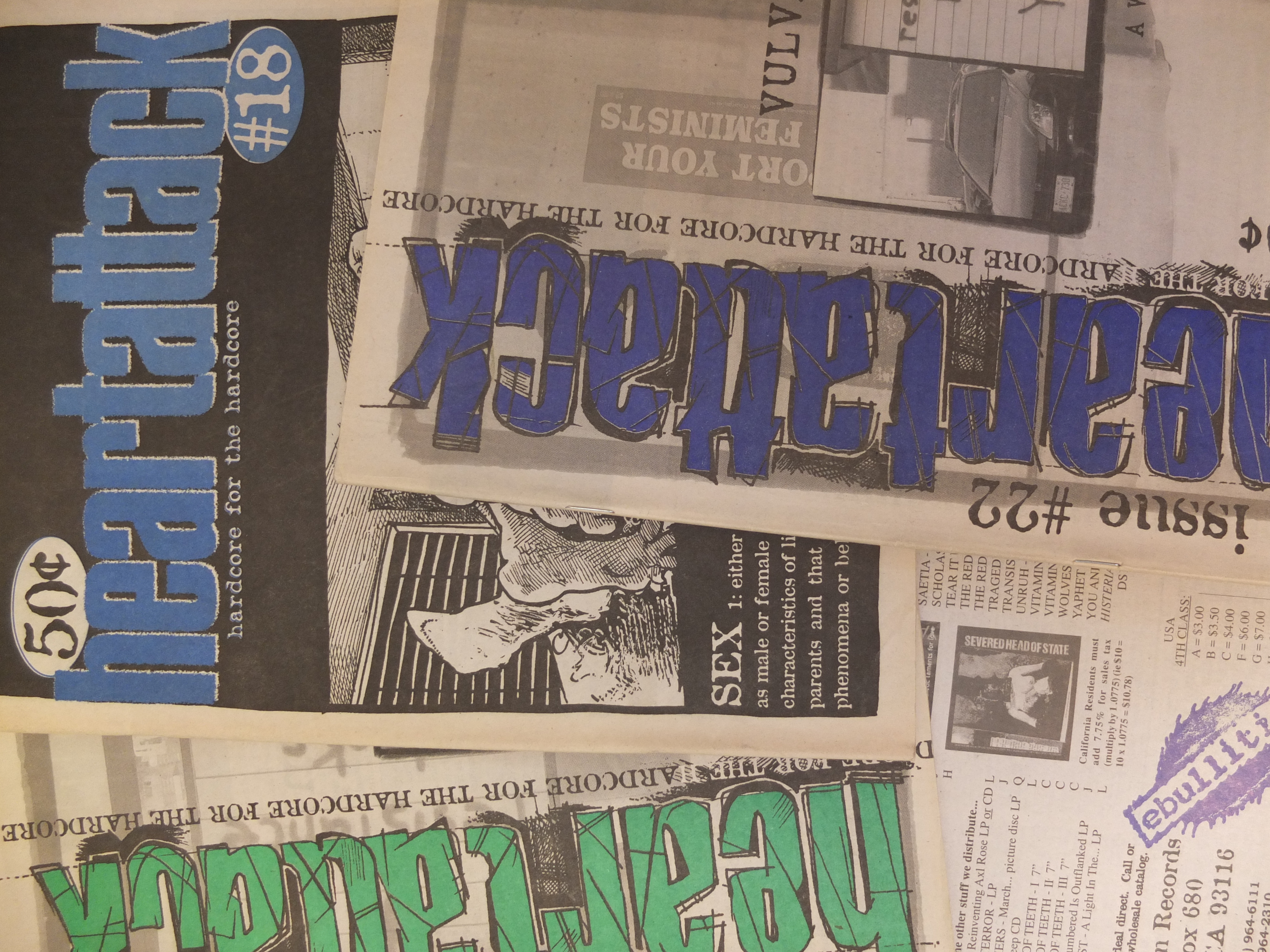
HeartattaCk has been archived online twice. One of these archives has already disappeared. Neither archive is authorized.
What do these archives look like? How do they function?
How could they be improved? Are there important features missing from these archives?
When I moved across the country to start a position at UBC in 2007, somehow my box of zines did not make it. I don’t know what storage location they were not collected from and to this day I remain convinced that they simply must be here despite all the evidence to the contrary. You know what they say about trying to prove a negative.
So, when I stumbled upon the digital archive created by Adam from Operation Phoenix Records, I was thrilled. That website later became a blog with links back to the original website. The Punk Zine Archive blog still exists to lift the hopes of others looking for an archive of HeartattaCk. But the content has all disappeared. Years ago, I tried reaching out to Adam to see if he wanted to share those scans issues via another means together, but I heard nothing back. It was a functional if unspectacular archive. The PDF scans were the colour of weathered newsprint and lots of the issues were there. I can’t recall it was a complete collection of the zine’s issues.
In 2018, Marek Loub published The HeartattaCk Archive. Loub notes how much these zines meant to him as a kid: “Most of these ideas and opinions which I found inside there hit me directly to the heart. I finally found somebody who has similar way of thinking as me. At that time it meant something.” Reading with a Czech-English dictionary by his side, he would “finish reading one HaC issue” in “approximately 14 days.” I can’t imagine the desire that drives one to learn English by reading HeartattaCk, but I get the feeling of connection and community that zines bring.
Several years later (20+) I want to see If “I can step twice into the same river.” I noticed that it’s almost impossible find any of these issues anywhere online for buy or download. After few weeks/months of searching I was able to find several issues as PDF version and also bought some hardcopy on eBay.
Marek Loub
The archive hosts the complete run of 50 issues of Heartattack. Some of the scans are of pretty weathered copies; others look almost new. The issues are not hosted on the website. Each issue is linked to mediafire where the PDF can be downloaded. Three years after the website launched, these links all remain active. The quality fluctuates with file sizes between 100-250MB. The website itself is a nice clean grid with all 50 issues represented by their covers on a single page.
In addition to HeartattaCk, Loub has uploaded scans of Different Life Fanzin and its successor Minority. These are scanned from masters and thus in many cases original photography is now available with a clarity that would not have been present in the original photocopied zine. While the archive does not identify if it has permission to digitize and distribute this material, Loub does include links to Ebullition perhaps in order to direct readers to some of the creators of this zine.
The HeartattaCk Archive contains a link to World of Need Clothing (a nice homage to the benefit compilation of Embrace covers “Land of Greed…World of Need”) as a way of generating revenue to support the website. Unpromisingly, that link is now dead. One hopes that a lack of funding does not lead this archive to disappear too.
So, what could these zine archives do better?
Obtaining permission seems like an important step. Both of these are archives are what Abigail De Kosnik calls a “rogue archive” created by community members interested in the content they are archiving. We need to think through if and how we make material available. It strikes me that this needs to start by listening to the desires of the creators. And this probably needs to include contributors, not just those who published the zine. No one thought they were writing for the internet in 1996. We were writing knowing that our words would stay within our community. Digitizing things and putting them online is a substantial change and that could have negative repercussions for some.
Hosting materials on-site might keep things alive longer. Certainly, local hosting offers another important possibility: a reading view that does not require downloading. Downloads and offline reading are not always very functional if one is on a phone.
Working from originals or masters rather than printed editions would be ideal if those can be obtained.
Ensuring financial sustainability is important too.
By George Grinnell
Rogue cultural memory is not essentially the product or tool of marginalized and minority groups; it may certainly be used to serve the interests of dominant classes and groups. But, over the past few decades, it has been effectively developed and deployed to strengthen the positions and fuel the activities of subordinated individuals and collectives, and to further projects of democratization.
Abigail De Kosnik
 Punk Pedagogy