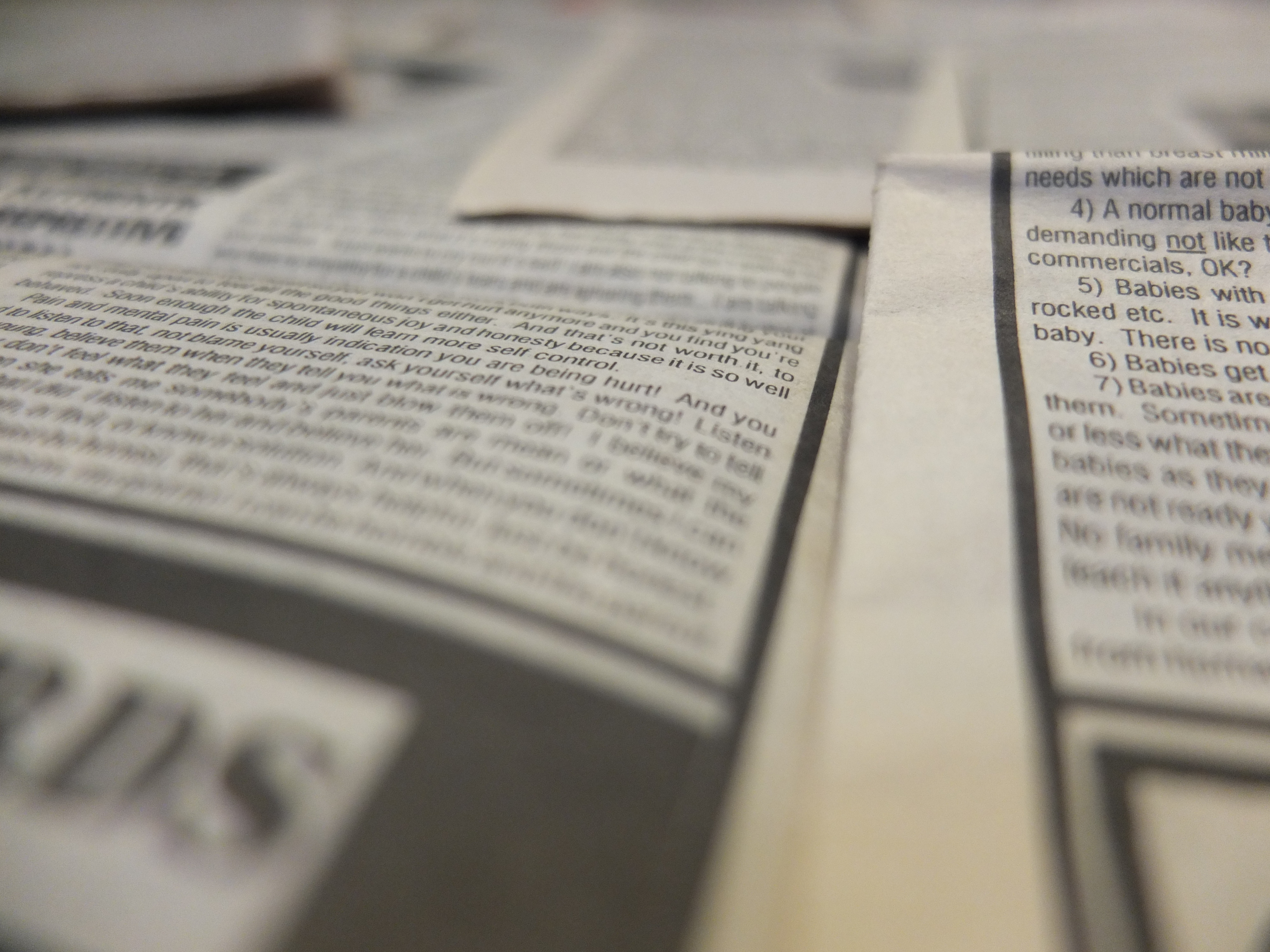
A description and assessment of several archives created and maintained by universities
Duke University Zine Collection

The Duke University library system holds a number of zine collections. They have personal archives donated by Sara Dyer, Dwayne Dixon, Lara Cohen, Edwin and Terry Murray, as well as themed collections.
The collection has over 3500 zines, most of which are published between the years 1985-2005. This archive is especially strong regarding themes of feminism and gender.
Access
The zines are not digitized and one must schedule a visit the library in order to access these materials.
Copyright
Because the zines are held offline, the copyright structure is what one would expect of a library archive: one can access material; reproductions must be requested via library staff; and advance notice of a visit may be required, as is common with any university archive. Additionally, Duke University specifies that “Researchers must register and agree to copyright and privacy laws before using this collection.”
Website
The website lists its collections according to donors, primarily. Clicking on an individual archive generates detailed information on topics and issues covered by the zines in that donor’s collection. Further clicking can reach a Research Guide that elaborates upon the contents of a given collection. The subject descriptions are not always what I would expect, however. Dixon’s collection of punk zines includes material from HeartattaCk, Contrascience, Dear Jesus, Born Against, Ferret, Jara, Simba, Punk Life, Wanna Communicate, Troubleman, and Universal Order of Armageddon; yet the subjects used to aid in finding material in the collection never once mention music or punk. One might be unlikely to discovery that this archive was relevant if one was searching for materials related to punk in the Duke Library system.
Barnard Zine Library
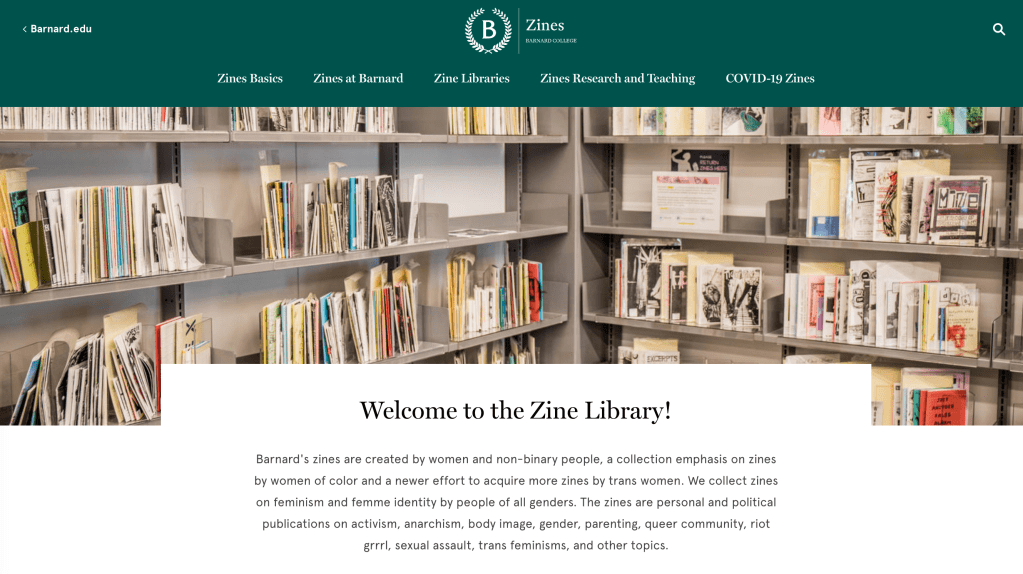
The Barnard Zine collection is part of the Columbia University library system and was started in 2003. It includes more than 11,000 issues, with 5,000 of them housed in the open library stacks where they can be read and photocopied by library patrons. Barnard librarians are staunch advocates for zine culture. Not only do they make these items widely available to see, handle, and read, they also theorize the value of zines on their website:
This collection aims to serve the needs of current readers and scholars and those of future researchers, Barnard and Columbia students and faculty, scholars from other academic institutions, and writers doing research for a major publishing house have used zines to research topics such as the Riot Grrrl movement, Sassy magazine, girls and education, radical parenting and other topics. Library science graduate students from around the city have visited and worked with us to learn more about collecting, cataloging and preserving alternative publications. We believe the collection will be an invaluable resource for future scholars. Zines are primary source documents that tell the story of contemporary life, culture, and politics in a multitude of women’s voices that might otherwise be lost. We also hope that current readers will enjoy the collection simply for its vibrancy, humanity, and artistic value.
Access
Approximately half the collection is publicly available in the library and can be checked out or read on site and the other half can be accessed via an appointment with the library archive. They appear to recognize that this collection may interest individuals not necessarily acquainted with a university library and they provide helpful instructions on how navigate a university library online search as well as how to interpret the results that it generates so that one can find materials in the actual library. They also helpfully invite patrons to contact a zine librarian directly if they need assistance with their search. The zines in the public collection are available to other institutions and their patrons via Interlibrary Loan.
Copyright
The vast majority of the collection is treated the same as any other book or magazine at a library and thus there are none of the copyright concerns that arise from digitizing and publishing material online.
Some zines are available online at https://zines.barnard.edu/barnard-zines-online-links. Most of the digitized materials have been published recently. I would assume that this means that the only materials that are shared online are ones where the library has been able to obtain explicit copyright permission to do so from the original creators. Permissions are not identified. Digital zines are stored on Google Drive servers. Some links were dead.
Website
This is the gold standard of academic zine archives and their web presence reflects that. The website is robust and indicative of a collection begun more than 15 years ago. It is clear that the collection matters to the library. There are posts of Zine Library News that feature new additions to the collection as well as upcoming events. The website includes a primer on “what is a zine?” as well as instructions on how to make one. They have a global list of zine libraries and links as well as guides to research and teaching using zines. They also share NYC-specific information, given their location in New York, suggesting that people might also consult places like the ABC-No-Rio Zine Library or the Riot Grrrl collection at the Fales Library Special Collections at NYU.
Cornell Punk Collections

The Cornell University Library system possesses the Johan Kugelberg and the Aaron Cometbus Punk and Underground Press collection. The Aaron Cometbus collection, for example, contains:
Flyers, posters, magazines, files, and zines relating to American punk and alternative culture collected or created by Aaron Cometbus, including his own work as a writer and musician. The archive contains hundreds of fanzines and small magazines, plus original manuscripts and paste-ups for Cometbus and related publishing and distribution records. Board games, business cards, set lists, and venue histories provide a personal, behind-the-scenes view of punk both as music and as a movement, from 1980 to the present.
While the Cornell University archive is substantially the product of a donation from Aaron Elliot, a longstanding contributor to punk culture in Oakland and San Francisco as well as Richmond VA, where he was a punk musician and the author of Cometbus zine, the public face of these archives are digitized punk flyers.
Access
The majority of the collection is not posted digitally. Collections are open for public access by appointment. The library specifies further conditions on access:
Due to the fragility and potential degradation of moving image and sound recordings, viewing and listening is limited to items that have been digitized. If an item is in another media format, you may request to have the item digitized for access. Information on ordering access copies may be found on the Division of Rare and Manuscript Collections webpage.
More than 2000 punk flyers – mostly gig posters, but not always that either – have been digitized and are available here https://digital.library.cornell.edu/collections/punkflyers
Copyright
For digitized material, the Cornell library utilizes the educational exemption in copyright:
These images are made available for non-profit, educational use. These works are protected by copyright, and permission and possible fees may be required from the owners of any copyright independently of the Library. It is the researcher’s obligation to determine and satisfy copyright or other use restrictions when publishing or otherwise distributing materials found in this collection. Researchers must make their own assessments of rights in light of their intended use. If you have any more information about an item you’ve seen on our website or if you are the author or copyright owner and believe our website has not properly attributed your work to you or has used it without permission, please contact the Division of Rare and Manuscript Collections with your contact information and a link to the relevant content.
Digitized punk flyers include information regarding how to cite the source of the file. Remaining offline objects held in the archives are available for viewing and one can request individual digital access.
Website
One can search and sort the digitized punk flyers in a variety of ways, including by date. One can also conduct keyword searches of this digital objects. A search for Fugazi, for instance, brought up 10 posters.
The offline archives are sorted by collection and are less searchable. For example, one can see the full contents of the almost 2,000 items, organized by object and then alphabetized, in the Aaron Cometbus collection at https://rmc.library.cornell.edu/EAD/htmldocs/RMM08107.html. This might not be the most elegant interface but it easy enough to navigate once one figures it out.
UCLA Punk Archive
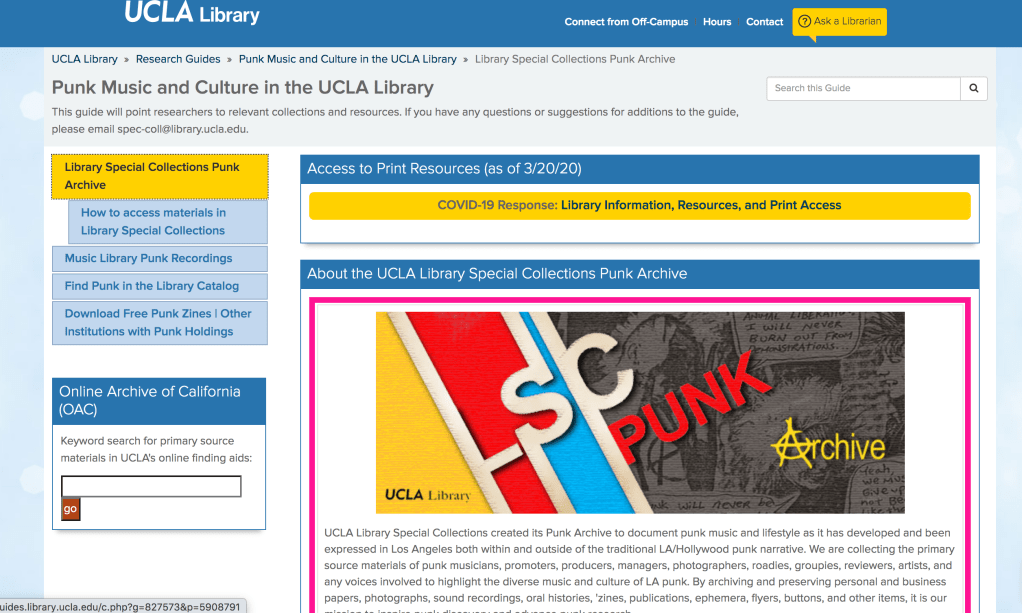
The UCLA Library system hosts a number of distinct collections of zines, ephemera, and music that together form the Punk Archive. These individual collections include donors such as Max Ward, Darby Romeo, Dawn Wirth, and Janet Cunningham. One of the unique features of this archive is that it is not exclusively a paper-based archive. It contains a number of audio and video recordings, including early punk compilations from L.A. and records from prominent California punk bands. There are 21 entries from NOFX and 5 for Minutemen, for example, in the library catalogue.
UCLA Library Special Collections created its Punk Archive to document punk music and lifestyle as it has developed and been expressed in Los Angeles both within and outside of the traditional LA/Hollywood punk narrative. We are collecting the primary source materials of punk musicians, promoters, producers, managers, photographers, roadies, groupies, reviewers, artists, and any voices involved to highlight the diverse music and culture of LA punk. By archiving and preserving personal and business papers, photographs, sound recordings, oral histories, ‘zines, publications, ephemera, flyers, buttons, and other items, it is our mission to inspire punk discovery and advance punk research.
Access
Physical objects such as zines and posters held in the archive are available to members of the UCLA community and the general public via appointment. Users curious to view a sample of these zines digitally, without visiting the UCLA Library, are directed to Circulation Zero, which might be a curious choice given that the website has no documented permission to share these materials.
One can search materials via the library catalogue and they provide helpful instructions on how to do so. Searching the entire collection generates 583 results. One can then sort by date and find Down By Law’s Blue album next to MRR’s Book Your Own Fucking Life from 1992, or a recording of X from 2005 followed by a Germs documentary from that same year.
Copyright
The majority of the Punk Archive is available in the Special Collections Reading Room and thus copyright is not an issue because the library is not publishing material online. Items in the collection can be photographed, with the following stipulations:
Readers agree that photographs may not be reproduced, donated, or sold to another repository, published, or exhibited without permission.
Collections with donor-imposed or legal restrictions that prohibit duplication may not be photographed.
Materials lent to UCLA LSC via Interlibrary Loan (ILL) may not be photographed unless specifically allowed by the loan agreement.
Taking pictures of the reading room, other readers, and LSC staff is prohibited.
Repositioning documents (e.g. holding documents up) to obtain better images is prohibited.
Cameras are not allowed to rest on top of materials.
Personal scanners, tripods, selfie sticks, camera flashes, extension cords, and special lighting are prohibited.
Website
While working within a UCLA-branded framework, the website is easy to navigate and the library system provides an excellent guide to the archive. It helps if one is familiar with the logic of a university library and how its search functions operate, but their guide is helpful and the collection is not so big that one cannot browse it.
By George Grinnell, Lea Sebastianis, Murat Yaman, and Rina Garcia Chua
In the next five years I was to learn what hard work was all about. Black Flag/SST was on a work ethic that I had never experienced and have never seen since. Greg, Chuck, and their nonstop roadie Mugger were the hardest working people I had ever seen. They went into whatever it was that we had to do without questioning the time it took, the lack of sleep or food. They just went for it. No one had time for anyone else’s complaining. If you ever made a noise about anything, Mugger would just start laughing and say something like “This isn’t Van Halen! Get it happening!”
Henry Rollins
Get in the Van: On the road with black flag
 Punk Pedagogy