The view from a teacher-in-training
…Stop. Stop thinking,
I plead to my mind,
These thoughts in abundance, so loud and unkind
I’m failing in school
Because I’m possessed
With the unsettling thoughts that it’s
Worthless and pointless.
I’M BORED, I scream!
This stuff is so dumb!
All I feel is numbness to these useless facts which lack life,
And quite frankly,
My interest….
At the height of my Punk-inspired teenage angst, I wrote this poem for a class project. Our job was to write a spoken-word piece that we would read out in front of the entire class, and I thought it to be the perfect opportunity to tell my teacher, publicly, how much I thought school sucked. Growing up, I hated school. Not only was I constantly bullied by my peers (which increased after reading this crap-poem out loud to the class), I earnestly hated the learning process. I hated sitting there in my boring desk, learning about boring subjects, while being talked at by a boring teacher. I hated it.
However, when given this opportunity to express myself, I worked really hard. I remember sitting in my most dreaded class, chemistry, and actually feeling an ounce of passion as I ignored the lecture to write up my spoken-word project.
I remember this poem word-for-word several years later because of that small ounce of passion I experienced, that’s how great of an impact emotion has on memory. I remember the excitement, thinking that other students would rally behind my expressions of school-hatred. I day-dreamed about how my boring teacher would be inspired to change his ways after hearing the cries of a suffering student, cries he’s never heard before due to his long and tedious lectures taking up ALL of the class space. Finally, the teacher would hear me. Finally, I would have my moment.
None of my day-dreams came to fruition, of course. Nothing radically changed. I got a B+ and people thought I was more weird than ever before. The usual. However, something did change inside of me that day; that little ounce of passion I felt, it stuck. I realized I wanted to make a difference. I realized that I wanted to be a teacher.
The irony! How can someone who expressed so much hatred for the educational institution want to spend their entire life working within that very system?
Once a young punk girl who despised high-school, I am now a future educator who starts the teaching program in August, so how can this be?
Originally, I attributed it to my “do-it-yourself” attitude. If other teachers were not going to support students in the way I felt that they should, I would be the one to do so. This attitude was a form of resistance to me, but it was also an attitude I did not realize was passed on by past generations of punk. This was until I took a fourth-year English class in 90’s DIY punk pedagogy. It was here that I gained access to punk zines, particularly HeartattaCk, and was able to learn about the various learning philosophies which inspired these past generations. It felt like I was learning about my history as I never truly reflected on my past involvement with this alternative subculture, or how it has impacted my life decisions. In HeartattaCk #38, The Education Issue, I discovered that I wasn’t alone as other punks also were inspired, for similar reasons, to become educators. This was the first time I sensed that there might be something about punk counterculture that produces good, passionate, teachers, no matter the time period. So the question is, what is it? What is it about punk that sometimes inspires individuals involved to become teachers, and what is it that sparks passion for learning and education? The answer, I argue, lies in the DIY ethos. Moved passionately by DIY, these teachers writing to HeartattaCk reveal the ways in which DIY principles transform into a passion for learning and education, and why incorporating such principles may benefit bored, uninspired, students like my fifteen-year-old self.
But first, I have to tell you what this DIY ethos is all about. For those of you who aren’t familiar, ethos is pretty much the driving characteristic or essence of a culture, or in this case subculture, as portrayed by its beliefs and/or aspirations. Yes, I got this definition from google. In terms of what this means for punk, DIY, or this philosophy of “doing-it-yourself,” encompasses punk’s principles and ethics. In a sense, DIY is one of punk’s foundational pillars. It means working together to create the culture we want. It means organizing culture around community and values rather than to prioritize profit. It means making what we believe in, whether that is profitable or not.
Originally, this DIY approach was embraced by the punk music scene to create bands, host shows, and release records. In fanzines like HeartattaCk, DIY ethics created a similar free space for creativity to flourish: without the pressures of profit, individuals are free to produce any type of content they desire. DIY, in this case then, functions to resist the status quo. As I’m sure you know, resisting cultural norms effortlessly aligns with punk counterculture. Craig O’Hara highlights the DIY ethos as an extension of anarchist principles which require “responsibility and co-operation in order to build a more productive, creative, and enjoyable future” (166). This quotation may seem odd, as anarchism is usually synonymous with violence and chaos. Co-operation? A creative and productive future? That isn’t anarchism! But actually, it is. This is because anarchism is driven by ethics of economic and political equality. This type of drive encourages positive principles like co-operation because the end-goal in anarchism is to build a better future. This cannot be done without co-operation. Moreover, this cannot be done without learning. This drive clearly transcends into the DIY ethos, as this ethos encourages both various forms of learning as well as the creation of spaces where different types of learning can occur.
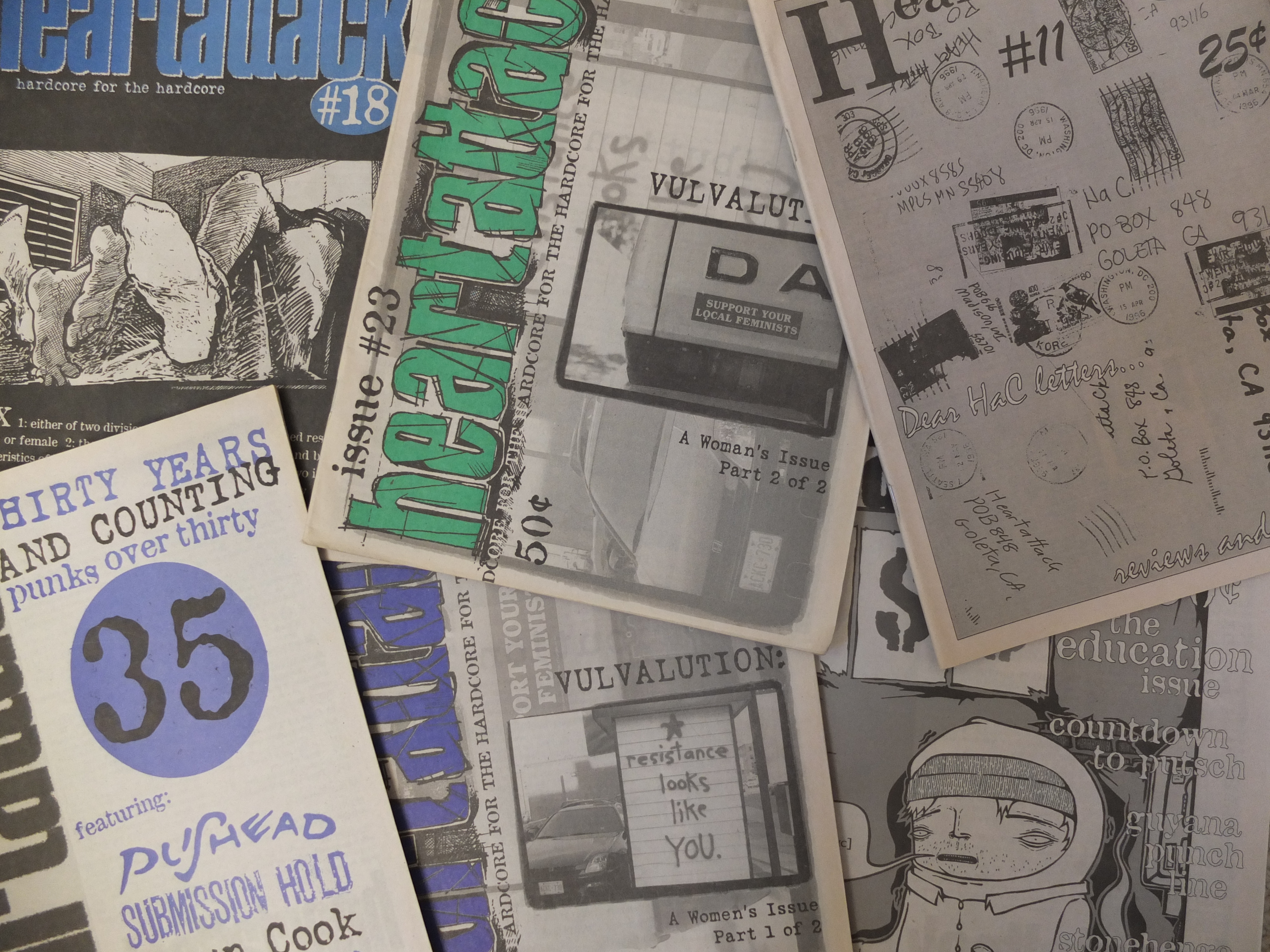
So now that we have a basic grasp of the DIY ethos, how does this ethos become a punk pedagogy? By rooting DIY back into its anarchist origins, we can see that one of DIY’s principles includes an emphasis on self-learning. To explain, in anarchist thought, the aim of learning and education is to help people gain necessary agency over their lives and minds so they can live those more creative and productive futures that anarchism strives for. In DIY, this type of learning involves resisting against status quo forms of education through the process of self-edification. This is a “do-it-yourself” type of learning which is encouraged by zines. This becomes evident in the graphics in HeartattaCk:

Placing these words together is brilliant. It creates a juxtaposition between the DIY principle of self-learning and the educational system’s function to indoctrinate. Moreover, the punks in HeartattaCk clearly prefer one over the other as a result of their passion for DIY. Most impassioned about the subject, it appears, was the writer “Veracious V.”
Veracious was previously an aspiring teacher. But 6 months before writing to HeartattaCk, Veracious dropped out because s/he was dissatisfied with the potential to change the school system in ways that would make it genuinely effective. Veracious explains how from the ages of 5 to 10, they “stayed at home and taught [themselves.]” Here is what Veracious has to say about self-learning:
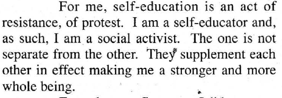
Unconvinced that one effectively learns in a structured environment, Veracious believes strongly in the values of DIY and self-learning. This is because, by growing up in an environment that focused on self-learning , Veracious was given the “the time, space, and respect” to realize their creativity, which provided them with the freedom to “exercise [his/her] own free will and liberation.” You may recognize that these types of learning outcomes are similar to the aims of education in anarchist thought. However, to achieve such aims, learning has to be undertaken by oneself first and foremost. This is done through self-edification.
Similarly, Eric M., who at the time of writing to HeartattaCk was a punk teaching at the college level, also places emphasis on the importance of self-education. Eric mentions that the only thing worse for a student “than being forced to go to high school is being forced to go to college.” He says that although he loved school and self-identified as a “nerd,” He recognizes that formal education does not work for everyone. This is what he has to say about the process of self-learning:
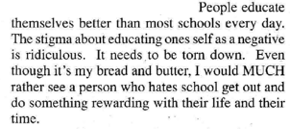
Both of these writers’ place emphasis on self-education because it is a principle instilled in them through punk’s DIY ethos. This is because the DIY ethos encourages a respect for various ways and forms of learning, as according to these two, education is not isolated to a classroom setting. Self-education is emphasized by Veracious and Eric because it allows the space for individuals to find what type of learning benefits them the most. This aspect of DIY is clearly rooted in a passion for learning and education– it just looks at such things in a different way. What’s different is that the prospect of self-education puts learners, and thus students, first.
Eric said it himself, that he much rather see a student thrive through self-education than stay in school if one hates it. To him, receiving valuable knowledge to help one live one’s best life is more important than whatever form it may come in.
Similarly, although Veracious V. dropped out of Education Studies, they are still so clearly passionate about the education system. Although this passion mostly manifests as critique, the passion for students and learning is still there. Veracious. pleads for “young people of this country” to demand for their “rights to be recognized, for [their] voices to be heard and listened to.” Refusing to support formal institutions does not mean refusing to support students. I don’t know about you, but my 15-year-old self would have loved to have a teacher encourage me to go on whatever educational path suited me best. My adolescent self would have loved to hear a teacher advocate for my voice, as well as the voices of other students, as something that ought to be heard and respected. Both Veracious V. and Eric M. demonstrate a passion for education and learning influenced by punk’s DIY principles and a steady recognition that doing it yourself means working together and supporting one another.
For punk, self-learning is part of a larger process which revolves around the individual educational needs of students. Students are put first and any education worthwhile, according to this principle, is centered around creating the conditions in which one can learn and be supported in learning. This type of learning, however, is not fully dependant on the individual as it also requires a community. Veracious V. makes this very clear.
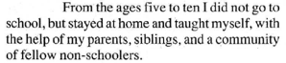
They taught themselves, but not without the support of their surrounding community.
…each person needs to figure out what works best individually. Then we can start learning to work together.
Eric M.
Therefore, it is clear that DIY’s emphasis on self-learning does not isolate individuals from an educational community. Rather, it encourages a type of community that leaves room for personalized learning and personal growth. Clearly, then, self-learning is a DIY principle that encourages a productive pedagogical space.
If education can happen anywhere, through this process of self-education, and therefore does not require formal institutions, does that mean that every educational space is equal? Are all educational spaces productive in the same way? The answer is no. That is because not all educational spaces allow space for critical thinking. The DIY ethos emphasizes the importance of this process because of its anarchist roots. This is because, similar to self-edification, critical thinking helps individuals reach that level of agency where what and how they learn helps them lead their most creative and productive lives.
So, what is the best way to develop one’s ability to critically think? First, one obviously needs the space to do so– a pedagogical space, which is pretty much a space for learning and teaching to occur. Fancy word, simply concept. Anyways, with various educational institutions promoting indoctrination, at least according to this issue of HeartattaCk, this type of space has to be created in order for critical thinking to occur. This is where the DIY ethos comes into play. The creation of zines like HeartattaCk, a formation that is incredibly DIY, provided the punk community with a free space to be critical. Zines might just be the educational institutions of punk rock! But education and punk rock are not always the easiest pairing, especially for those pursuing formal education and teaching.
Evan K. had just finished his seventh month of teaching when he wrote to HeartattaCk, reflecting on why, at times, it is hard to be a punk and a teacher. He begins his anecdote by stating how he is 99% sure that without being involved in the punk community, he would have never become a teacher.
…most of what I consider to my most valuable education came in some form from my involvement in the punk community.
Evan K.
The punk community provided him with various ideals and values in regards to what it means to teach and learn. In order to desire change, one has to realize that there is a problem– that there is something they want to fix. The first step to such a realization is critical thinking. When Evan says that he would not have become a teacher if it wasn’t for his involvement with the punk community, I truly believe he is onto something. Moved passionately by DIY and its ethics, such as self-learning and critical thinking, these punks, who in some way or another were inspired to become teachers, are impassioned to put students first; and through critical thinking, they have the ability to identify problems and seek change in order to do so. That is how DIY instills passion for learning and education, by providing pedagogical spaces for such thinking to occur. By encouraging change.
So, my thought is this: critically thinking about education has potential to transform into a passion for education. This is because, through critical engagement, punks are able to identify various needs for change. To actually put effort into changing something, someone has to be passionate about that change.
So, what types of changes are we talking about here?
Now that we have talked about the potential for DIY principles to instill passion into punks for learning and education, we can finally answer my last question as to why incorporating such principles may benefit bored, uninspired, students like my fifteen-year-old self. Well, the first benefit is that DIY principles, like self-edification and critical thinking, undermine the power dynamic between student and teacher by encouraging communication. This is a dynamic that I do think needs to be changed.
Thinking back to my experience in school, and how bored and uninspired I felt being talked at by a teacher, it is so clear that this dynamic isn’t always healthy in terms of learning.
I understand that not all good teachers are punks, and not all punks are good teachers. All I am saying is that perhaps there is something about punk that encourages a passion for learning– a passion for education. I have related this “something” to the DIY ethos, but there could be lots of different “somethings” still begging to be discovered. These things need to be studied further, and more thoroughly. Because, honestly, what do I know?
All I know is that at 15 years old I hated school. I hated sitting in a boring classroom– a space where only the boring teacher was allowed to speak. But, when I was given a free space to write, to vocalize and share my thoughts, what sparked in me was a passion for education because I realized that I wanted to make a change. This moment of expression was quite brief for me. I didn’t talk in front of a class again until I attended university. But, passion is a powerful thing.
I wanted to become a teacher so I could create a similar space which would last longer than a brief moment; a space where students can find their passions and share their thoughts, without being oppressed by an assumption that they no nothing. I wanted to bring positive change to a problematic system, because I am passionate about it. Isn’t passion what makes a good teacher?
By C. Z.
Punk will be limiting as long as someone else defines what it is. Why let someone else, under any circumstances, represent you? Why let group mandates guide your decisions? The aspects of punk that I appreciated valued community action but also individual thought.
Anne Elizabeth Moore
From, Beyond The music: How Punks are saving the world with DIY ethics, skills, & Values
 Punk Pedagogy