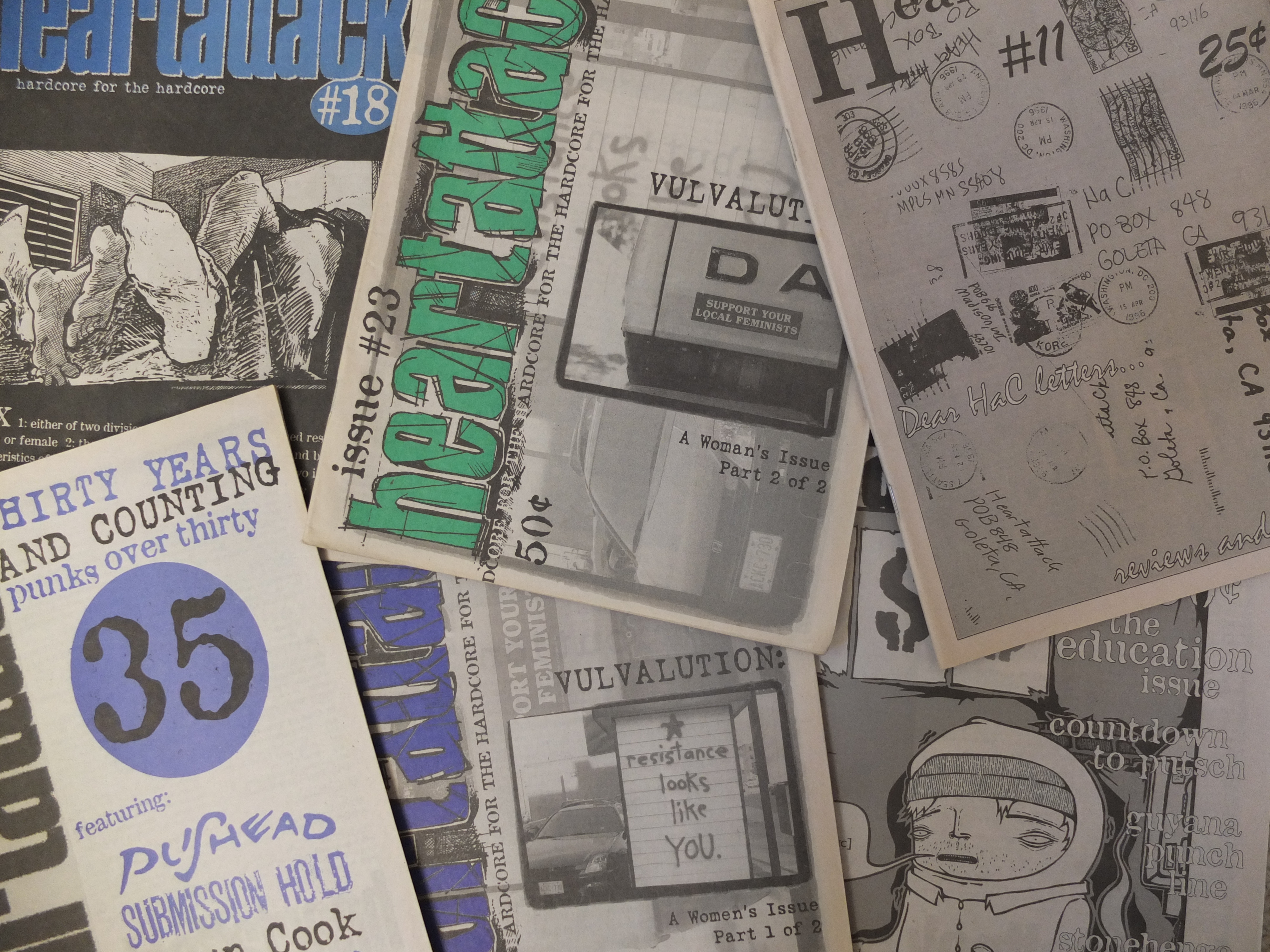
A Feminist Analysis of HeartattaCk Zines
Re-Thinking Punk
Punk as a subculture may be characterized as pedagogical because of the ways in which it addresses issues surrounding social inequality. Punk utilizes pedagogy to question mainstream society and the invisible power structures which reinforce harmful attitudes towards women’s bodies. Women who participate within the punk subculture reject dominant ideologies which contribute to their oppression. Indeed, women have always been active participants within the punk scene and continue to challenge societal expectations surrounding gender and sexuality. Women in punk reject conventional notions of femininity and continue to speak out against the patriarchal structures which have so often silenced their voices. Women have also turned to punk to find community and create solidarity amongst themselves and this is especially important within a subculture where men significantly outnumber women.
Women’s involvement in the scene is particularly evident in HeartattaCk, a popular zine which exemplifies the “do it yourself” ethic of punk. HeartattaCk editors Leslie and Lisa are behind a lot of the work which goes into the zine’s production and issues #18, #22 and #23 are particularly representative of women’s involvement in punk zine culture and how they can be used as a feminist tool for resistance. In addition, zines are an effective medium for communication because of the ways in which they circulate controversial ideas and political messages but do so via personal narratives. The perspectives which are included in these issues of HeartattaCk reflect a feminist tradition which speaks to the personal being political. It is also worth noting that anybody can make a zine, they are often collectively written and they are meant to be interpreted, contested and reciprocated. In this way, zines are a creative way to circulate ideas which start a conversation about gender oppression. As an analysis of these special issues of HeartattaCk will demonstrate, the creation of zines offers readers a glimpse into the lived experiences of women and leads to wider questions of gender and sexuality.
#18: The Sex Issue
I don’t fit in a box. And my sexuality isn’t defined in some dictionary. I am a human being. The complexity is overwhelming.
Kent M.
The Sex Issue begins with an article about sex written by Kent, who explores how sex is often described in negative terms, specifically in a hardcore scene that seeks to address issues of rape, homophobia, objectification and discrimination. He is concerned that solutions for this complex problems are often reduced to abstinence and the denial of sexuality. Thus, he sees value in discussing the positive aspects of sex and how it can be a liberating experience for some. Kent acknowledges how HeartattaCk’s “value is in fostering a realm to discuss issues. At no point has HaC ever encapsulated the complexity of any issue, and I don’t think it will be possible for HaC to ever to do so in the future” (16). He recognizes how “sexuality is part of the human experience, and it is perhaps one of the most complex aspects of that experience. Our definitions of what it means to be human are different, and our definitions of sexuality are also different” (16). This statement creates an opening for a wider understanding of sexuality and desire.
Kent’s introduction to this issue calls for acceptance because he says “what follows are just thoughts that people have about their sexuality. If you want to search for right and wrong within their words then that is your decision, but perhaps once in a while we all need to spend more time just listening and trying to understand differences rather than trying to define everything” (16).
Nowhere is this idea that we need to appreciate a broader range of experiences and move past categories and definitions clearer than in the alternative this issue provides to mainstream culture’s paranoia of female sexuality and the pleasures it can offer. This special issue reflects a tradition of feminist writers who assert female desire in positive terms rather than reproduce social conventions that tend to see women’s sexual roles defined by the pleasures of men. Female desire is often described as relying on the presence of men, thus contributing to view of women’s sexuality as passive. However, the female writers in HeartattaCk write about their active roles to reclaim their sexuality from patriarchal modes of thinking which do not take the female experience into consideration. HeartattaCk features writers like Vique Simba who speak openly about women’s desire and sexual experiences to provide a description of sexuality which challenges dominant narratives surrounding sex. Vique Simba writes
penises – they are funny things. Boys tend to think them ugly and are remarkably insecure about them. I think they are beautiful, and I think size isn’t a particularly important characteristic. I notice how big it is, sure, but it’s about so many other things. I notice the angle, the shape, the skin, the hardness, the everything. But most of all I notice what they like and what I can do that makes them feel good. (20)
She continues to describe a positive sexual encounter and does not shy away from talking about the ways in which sex can be empowering for women. She concludes by noting that she “thought it would be interesting to write about dicks, instead of sex, from a woman’s point of view. I nearly wrote about female masturbation, or something like that, but I then decided that I would eventually write about what turns me on in the end” (20). Her column is constructive for the feminist movement because she moves away from a narrative which stigmatizes women who choose to participate in sex for pleasure rather than simply as a reproductive function. These candid conversations around sex present a multiplicity of views and experiences rather than only one way to engage in intimate relationships. This is pedagogical because it provides a broader understanding of female sexuality and may lead to productive conversations about negotiating boundaries, communicating desires and maintaining sexual health rather than strictly focusing on abstinence and monogamy which may result in a stigmatizing of women’s bodies.
#22: Vulvalution: A Women’s Issue Part 1
This issue of HeartattaCk is largely filled with content created by women. I frequently hear people comment on the fact that there are ‘no women in the punk community.’ That statement is simply not true. There are women kicking ass in all aspects – from booking shows to working in collectives to writing zines to playing in bands to simply being awesome people that live their lives in ways that make themselves and the people around them think.
Leslie K.
The Women’s Issue Part 1 and 2 highlight women who are actively involved in the Punk scene by showcasing bands with female members. Notable bands include Mankind?, Gaia, Insurgence, Spitboy, 2.5 Children Inc, Instant Girl, Jesus Crust, Laughing Hyenas, Sake, Anti-Product, Summer’s Eve, 13, Holy Rollers, Suicidal Supermarket Trolleys, Desiderata and One by One, among many others.
Women’s involvement within the scene is documented through their participation in bands and contributions to zines through interviews, writing and publishing. Their involvement is important to creating a cultural memory which includes perspectives from voices which might have otherwise been marginalized due to multiple intersections of identity which include gender, race and sexuality.
Leslie notes how the Women’s Issues of HeartattaCk should not be considered as a token issue which features women because “the presence of punk women (and of everyone else, for that matter) ought to be represented in every issue, but for that to happen, people need to write in and take full advantage of the forum” (3). Leslie calls for all women to contribute to HeartattaCk so they are able to archive their presence. She hopes that “these two lady-centered issues of HeartattaCk can, in some way, remind everyone of all the brilliantly wonderful women involved in punk rock. Never ignore or forget these women. To do so would be your great loss. Women as thinkers, women as artists, women as writers, women as cooks, women as supporters, women as musicians, women as shit-workers, women as activists…” (3). There is a diversity of women involved in the punk subculture and overlooking them would result in the erasure of their contributions to the scene.
A Women’s Issue Part 1 also builds upon many of the discussions presented in The Sex Issue. The following photo and text by Kandis provides an example of the ways in which women might engage in a positive sexual relationship with themselves. This topic is typically deemed taboo but Kandis’ testimony reveals how masturbation offers her relief from previous experiences of sexual violence. The ability for Kandis to feel in control of her own body allowed her to reclaim sex in a positive and safe environment. The image presents a hand-written note by Kandis, who writes “I reclaimed sex as a positive force in my life something that makes me feel good + has taught me to love myself […] I fuck myself without apology or guilt / a truly radical act” (44).
#23: Vulvalution: A Women’s Issue Part 2
A light went off in my head and I realized that I could get much more out of the scene than simple entertainment. I understood that there was a place for me because there were women out there doing things, being totally involved. This may seem silly now, but at that age (regardless of the fact that I was a feminist) I hadn’t really gotten the courage to be involved in things so personally.
Lisa O.
Part two of HeartattaCk, A Women’s Issue begins with a foreword from the editor Lisa who describes how she felt the need to prove herself when she first started attending punk shows because the crowds were predominantly men. She said the first few months were challenging because she wanted to prove that she was there for the same reasons as men. She says “no matter how many barrettes it took to insure my hair wouldn’t be pulled, no matter how much it hurt my spindly body to be crunched by someone jumping off the stage, I was going to stay. I didn’t hold coats and I didn’t sit around for fear of giving off the wrong impression. I was there for myself.” (3). She explains how as time passed she gained more confidence and began getting involved in other areas of the scene which allowed her to develop a strong sense of self. She notes that “hardcore gave me a sense of self-worth I can’t even describe. And it just happened because I didn’t give up. You can’t give up early if you want to get the most out of hardcore” (3). Lisa persevered to create a space for herself and other women in the small punk scene of her hometown in Southern California. Lisa could see the value in the growing punk scene because of the ways in which it allowed her to “question everything within my life and outside my life” and she saw the importance of “just having a community that openly deals with issues” (3). Lisa’s story represents how punk is pedagogical because of the ways in which is it seeks to question power relations in society and advocate for women’s involvement in all aspects of social and political life.
Another piece which is featured in A Women’s Issue Part 2 is written by Jen Angel where she examines how zines function as empowerment. Jen Angel advances her argument through four parts: theory, women, practicalities and the end.
In part one on theory, she discusses how zines facilitate learning by fostering voices in the community. Zines are a “consistent avenue of expression and dialog” (24) which allows women writers to gain confidence in expressing their opinions. Zines are “an avenue to make change happen” (24) by giving people the tools and connections needed to make that change happen. In part two on women, Jen Angel describes how zines “do things that are not done in other print media, in and out of our subculture. We talk about personal things and the personal aspects of how politics and culture affect our lives” (24). Part three talks about practicalities and the DIY aesthetic of zine culture to show how their production requires a lot of time and resources with no return on profit. Jen Angel highlights that anyone can make a zine and provides some suggestions for those who want to get involved with making their own. She suggests being persistent in the face of adversity, having a clear idea of the messages you want to communicate and learning from other zine writers. Jen Angel’s conclusion in part four is a call for readers to recognize the potential of zines because they are more “time sensitive [than music], contain a greater volume of information and opinion, and allow a two-way dialogue to occur much more easily then records do” (24). Therefore, zines are an educational tool which supplement the music that is so widely recognized and distributed within the punk scene. More, zines document that punk has always been about more than just music.
Punk as Social Movement
The brief outline of HeartattaCk issues #18, #22 and #23 offer but a glimpse into the subculture’s engagement with education surrounding social issues. Contrary to stereotypical representations of punk, people who are involved within the scene are deeply committed to issues of inequality and gender oppression. The way punks become involved within their communities in many ways resembles the organizational skills required to lead social movements. Women in punk organize around special causes and fundraisers to bring attention to the aspects of society which need restructuring. Furthermore, women in punk are responding to the unequal distributions of power inherent to the fabrics of society, so they continue to speak out against the oppression they face, both within the community at large and their subculture. Many of the writers who contribute to HeartattaCk utilize a stream of consciousness writing style that is particularly effective for communicating women’s lived experiences. Their work is marked by a feminist aesthetic of collective writing and these stories make the personal political. The turn to intimacy and personal life is a rejection of social scripts which seek to reduce women’s experiences to a single story. Women in punk challenge stereotypes by highlighting the complexities of their everyday lives as well as the connections and differences among women.
Women’s Voices in Punk
Every act of expression takes some bit of control away from those who want to monopolize our voices – it can be expression in the form of columns in zines or through making your own clothing or participating in direct action or calling people on racist/sexist/homophobic/classist attitudes or any one of many other things. The most important part is simply the expression of opinion
Leslie K.
Many people might be surprised to find a feminist tradition within the punk movement, but these values continue to be transmitted through women’s involvement within the scene. Punk is best characterized as a movement, not a moment or a trend, which goes to show how punk’s core values extend beyond music because of its investment in education around pressing social issues. Those who turn to the punk subculture are unhappy with the restrictions placed upon them by mainstream society and refuse to passively accept these oppressive conditions. Women in punk create a more inclusive space within the scene by asking questions and creating collectives and networks. They also use their platform to draw attention to social injustices and start conversations to initiate change. Punk is a platform which allows women to speak up against gendered oppression in a way that dismantles patriarchal ideals. Finally, Leslie summarizes how “the people who wrote in this issue of HeartattaCk are no different than you. We are all simply people, and we all have something to say. In a world that constantly tells you to step into line and shut up, it can be a great challenge to open your mouth and speak. Even though it may not be easy, it is important – because if you don’t speak for yourself then somebody will undoubtedly speak for you” (HeartattaCk 22, 3). The ways in which women commit to the DIY culture of punk through written expression is a powerful instance of a feminist pedagogy. This is a pedagogy that is especially attentive to what it means to be a woman in punk because it advances feminist values of expression which are dedicated to building a strong sense of community.
By A. H.
Punk will be limiting as long as someone else defines what it is. Why let someone else, under any circumstances, represent you? Why let group mandates guide your decisions? The aspects of punk that I appreciated valued community action but also individual thought.
Anne Elizabeth Moore
From, Beyond The music: How Punks are saving the world with DIY ethics, skills, & Values
 Punk Pedagogy